18 articles about Print App (Driver)

Linux Print App Troubleshooting Logs

If the Linux Print App encounters problems, submit print app logs first when possible. Logs help wēpa support review upload, login, CUPS, or print app issues.

If the built-in log collection option does not work, use the manual log retrieval section below. The Linux x64 and ARM64 Debian packages use the same log locations.

Submit Print App Logs

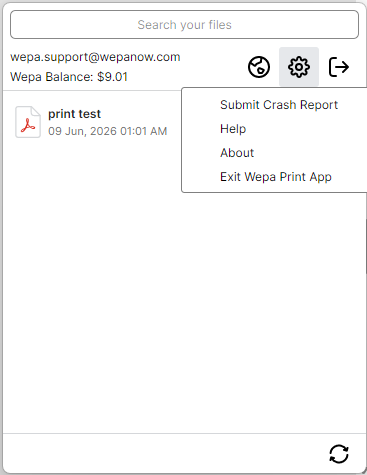
Open the Linux Print App settings view, then select Submit Crash Report to collect support logs.
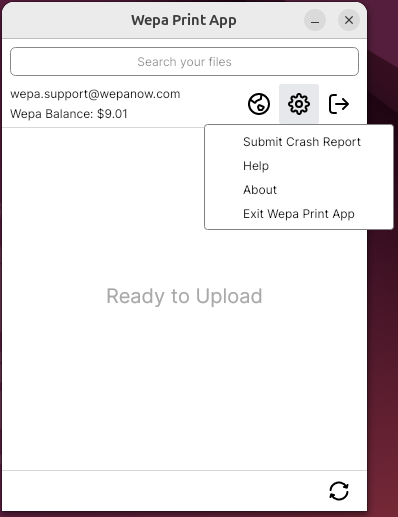
Linux Print App settings screen with Submit Crash Report option

You can also open Wepa Print App Utility from the application menu. The utility launches the Linux crash reporter located at /usr/lib/wepa-lpa/CrashReporter.
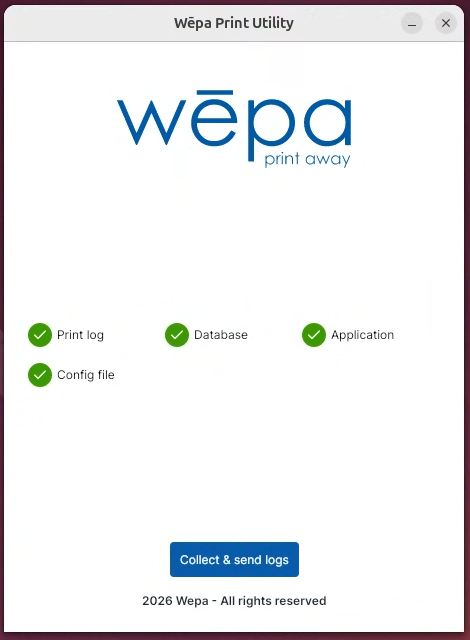
Linux Wepa Print App Utility with collect logs option

A Send Logs message will appear after the logs are collected. Select OK to open your email app automatically with the logs attached.
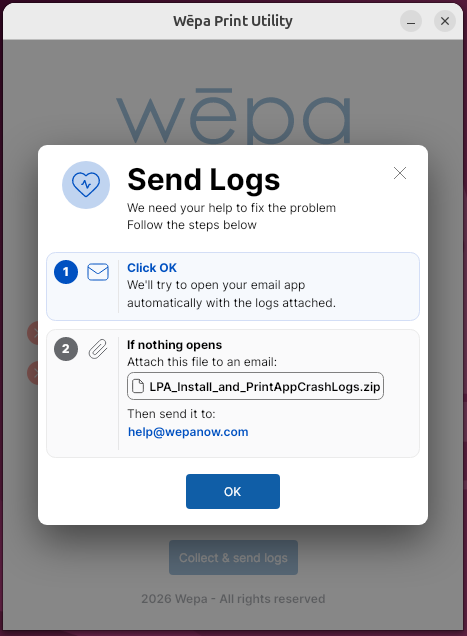
Linux Wepa Print App Utility send logs dialog
Include a brief description of the issue before sending the email so wēpa support can better understand what happened.
If an email window does not open, the utility will open a folder on your computer that contains the generated log zip file. Create a new email to help@wepanow.com, attach LPA_Install_and_PrintAppCrashLogs.zip from that folder, and include a brief description of the issue.

Manual Log Retrieval

If you cannot submit logs from the Linux Print App, manually retrieve the files below and send them to help@wepanow.com with a brief description of the issue.

Log Type Linux Location What to Send
Print app logs /var/log/com.wepa.printapp/ Send PrintApp.log. If present, also send PrintApp.Secondary.log and any other recent files in this folder.
CUPS / PDF queue log /var/log/com.wepa.printapp/wpapdfqueue_log Send this file for print, CUPS, print-to-PDF, or file processing issues.
Crash logs /var/log/com.wepa.printapp/ Send any recent timestamped .txt files from this folder. Crash logs are created when unhandled exceptions occur.
Generated zip from utility ~/Documents/LPA_Install_and_PrintAppCrashLogs.zip This zip file is created after the log collection utility runs. Send this file if the utility opens the folder but does not open an email window.
Shared settings /var/lib/Wepa/Settings.xml Send this file if the issue appears related to lab configuration, school selection, login behavior, timeout settings, or guest printing.
User spool files /var/spool/WepaQueue/<linux_username>/ Send recent .json metadata files if support requests them. Replace <linux_username> with the Linux account that was printing.
CUPS logs /var/log/cups/access_log*
/var/log/cups/error_log*
Send these files for printer queue, CUPS, or backend/filter issues. error_log is especially useful for Linux print failures.

Open the Linux print app log folder

Open Terminal and list the Linux Print App log folder:

ls -la /var/log/com.wepa.printapp/

Attach PrintApp.log, wpapdfqueue_log, and any recent timestamped .txt crash files. If PrintApp.Secondary.log is present, attach that file as well.

Open the generated zip location

The generated zip file is created only after the log collection utility runs. If the utility opens a folder but does not open an email window, attach the zip file from your Documents folder:

~/Documents/LPA_Install_and_PrintAppCrashLogs.zip

Attach LPA_Install_and_PrintAppCrashLogs.zip to a new email and send it to help@wepanow.com with a brief description of the issue.

Tip: On Linux, app logs and crash logs are stored in the same folder: /var/log/com.wepa.printapp/. For CUPS-related printing issues, include wpapdfqueue_log and the CUPS error logs when possible.

Optional Support Bundle

If wēpa support asks for a manual bundle, replace <linux_username> with the Linux account that was printing, then run:

sudo tar czf ~/wepa-lpa-logs-$(date +%Y%m%d).tar.gz \ /var/log/com.wepa.printapp/ \ /var/lib/Wepa/Settings.xml \ /var/spool/WepaQueue/<linux_username>/ \ /var/log/cups/access_log* \ /var/log/cups/error_log* 2>/dev/null

Attach the generated wepa-lpa-logs-YYYYMMDD.tar.gz file to a new email and send it to help@wepanow.com.

When contacting support, include the Linux username that was signed in when printing, the approximate time the issue occurred, whether the issue was upload, app/login, or printing/CUPS related, and the document name or file type if the issue happened during upload.

Package Install Issues

Linux does not have a dedicated wēpa app-managed install log. If the issue is related to package installation, upgrade, or removal, check the package and system logs instead.

Confirm the package is installed

dpkg -l wepa-lpa

Review Debian package history

grep -i "wepa-lpa" /var/log/dpkg.log
Note: For CUPS service or printer queue issues, your IT team may also review system journal entries and CUPS logs.

Log Notes

  • The Linux x64 and ARM64 Debian packages use the same log, config, and spool paths.
  • The main Linux print app log file is PrintApp.log.
  • If a second instance of the app is running, PrintApp.Secondary.log may also be present.
  • wpapdfqueue_log is important for Linux print, CUPS, and print-to-PDF pipeline issues.
  • Linux print app logs and timestamped crash .txt files are located in /var/log/com.wepa.printapp/.
  • The generated crash report zip, LPA_Install_and_PrintAppCrashLogs.zip, is created in the user’s Documents folder after the log collection utility runs.
  • There is no dedicated Linux app-managed install log. For package install issues, review dpkg or system logs.
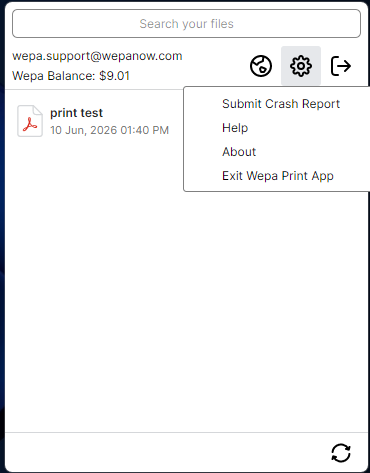
Send the logs to help@wepanow.com and include what happened, the approximate time the issue occurred, and the document name or file type if the issue happened during upload.

Submit Crash Report

The Windows Print App, Mac Print App, and Mobile Print App include options to submit crash reports and logs if uploading a document encounters problems.

Crash reports help wēpa support review application logs and troubleshoot upload, login, or print app issues.

Windows Print App

Open the Windows Print App settings view, then select Submit Crash Report to collect support logs.
Windows Print App settings screen with Submit Crash Report button

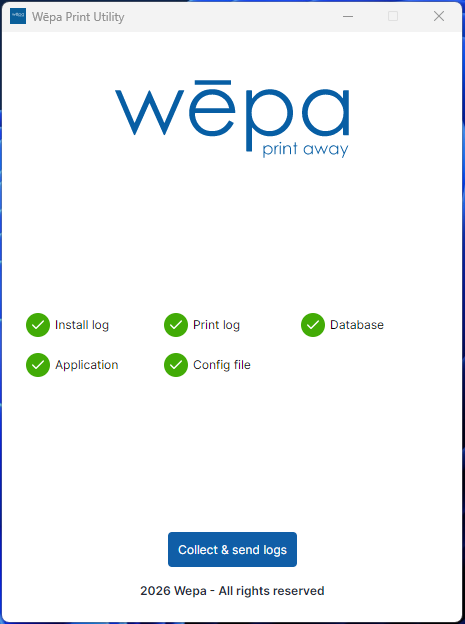
The log collection view will appear. Select Collect & send logs to collect the necessary log files.

Windows Print App log collection view with Collect and send logs option

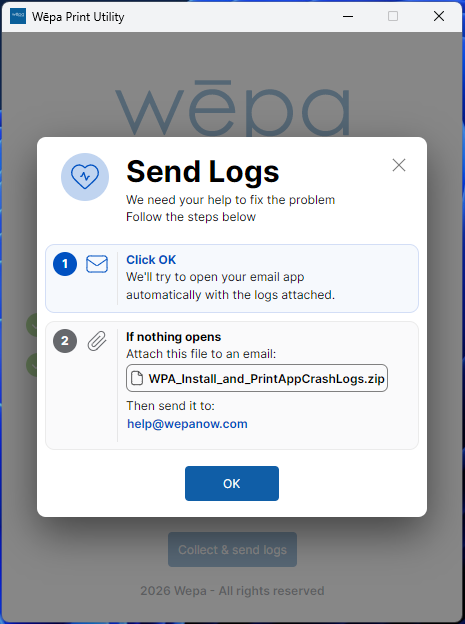
A Send Logs message will appear after the logs are collected. Select OK to open your email app automatically with the logs attached.

Windows Print App confirmation message after collecting logs
Include a brief description of the issue before sending the email so wēpa support can better understand what happened.
If an email window does not open, the utility will open a folder on your computer that contains the generated log zip file. Create a new email to help@wepanow.com, attach the zip file from that folder, and include a brief description of the issue.

Mac Print App

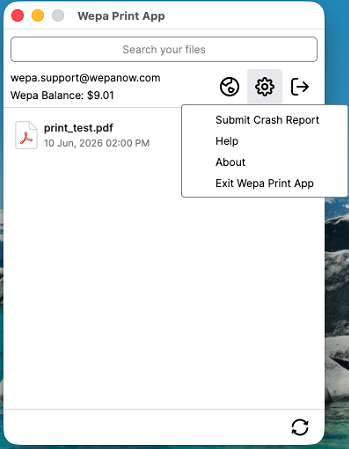
Open the Mac Print App settings view, then select Submit Crash Report to collect support logs.
Mac Print App settings screen with Submit Crash Report option

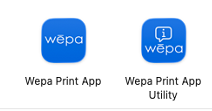
You can also open Wepa Print App Utility from the Applications folder. It should be located beside the main Wepa Print App application.

Mac Applications folder showing Wepa Print App and Wepa Print App Utility

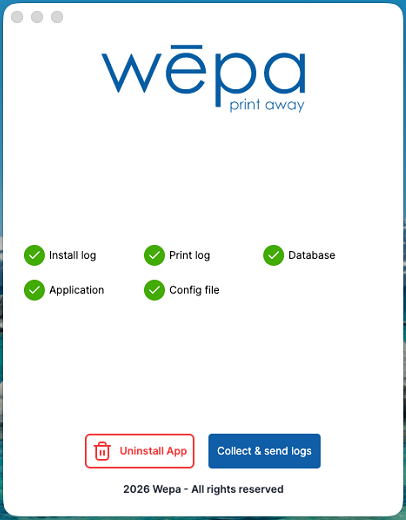
In Wepa Print App Utility, select Collect & send logs to collect the necessary log files.

Wepa Print App Utility with Collect and send logs option

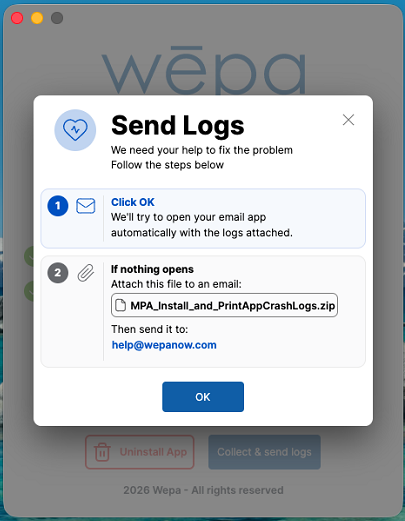
A Send Logs message will appear after the logs are collected. Select OK to open your email app automatically with the logs attached.

Wepa Print App Utility send logs confirmation dialog
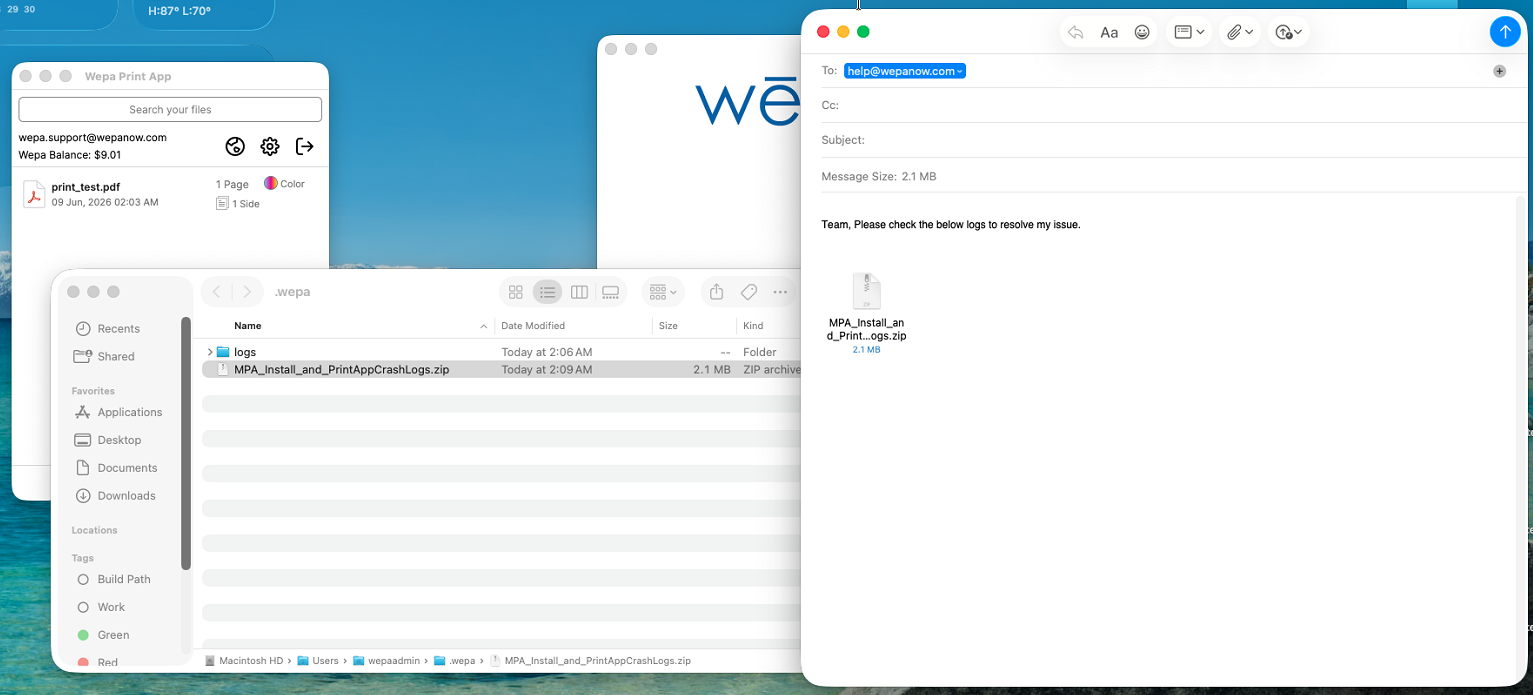
Include a brief description of the issue before sending the email so wēpa support can better understand what happened.
Mac Mail message with Wepa Print App crash logs attached
If an email window does not open, the utility will open a folder on your computer that contains the generated log zip file. Create a new email to help@wepanow.com, attach the zip file from that folder, and include a brief description of the issue.

Mobile Print App

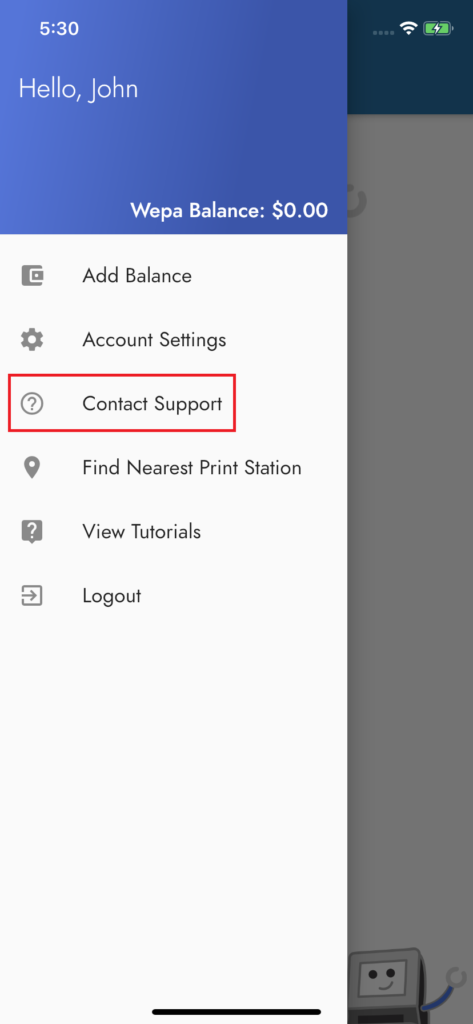
Tap the three horizontal lines in top left corner on the main screen of Mobile Print App followed by tapping the Contact Support icon highlighted below:

Mobile Print App Contact Support option highlighted

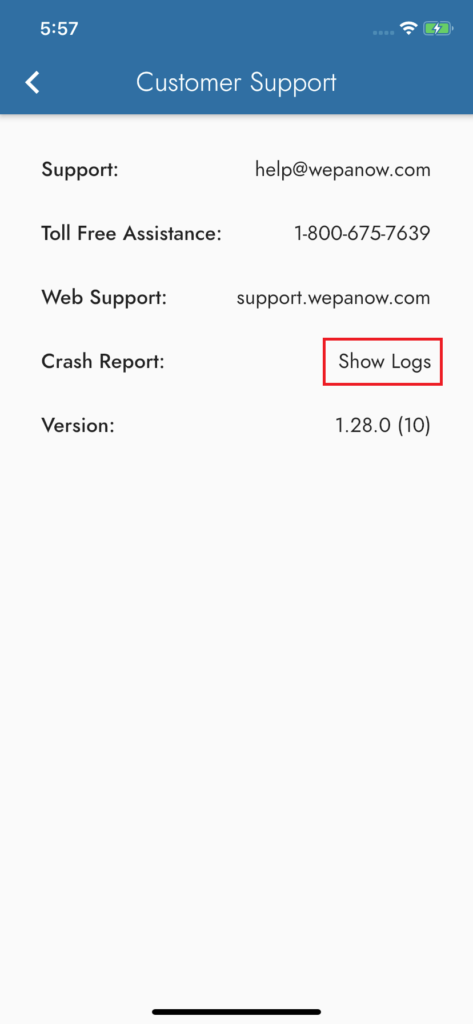
Tap Show Logs highlighted below to open the mobile app log.

Mobile Print App Show Logs option highlighted

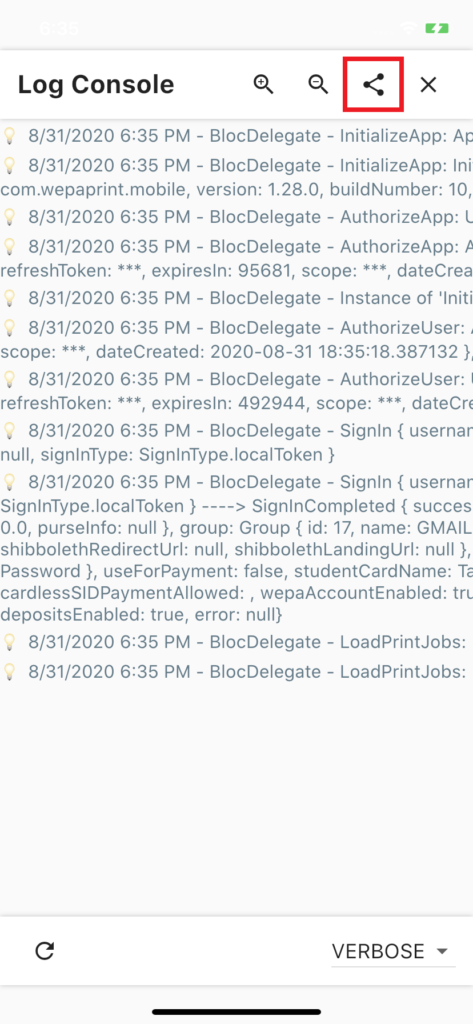
Next, select the share icon at the top highlighted below and select your preferred email client. An email will launch with an attached log. Enter any relevant information and send the email to help@wepanow.com.

Mobile Print App log console share icon highlighted

Print App: Upload Documents

Upload documents using the Windows Print App, Mac Print App, or Linux Print App. Open your document in its default software, select File > Print, choose a wēpa printer, then select Print.

Open the Print Window

Open the document normally within its default software, such as Word, Excel, PowerPoint, Preview, Adobe Reader, or another supported application. Then select File > Print.

Select a wēpa Printer

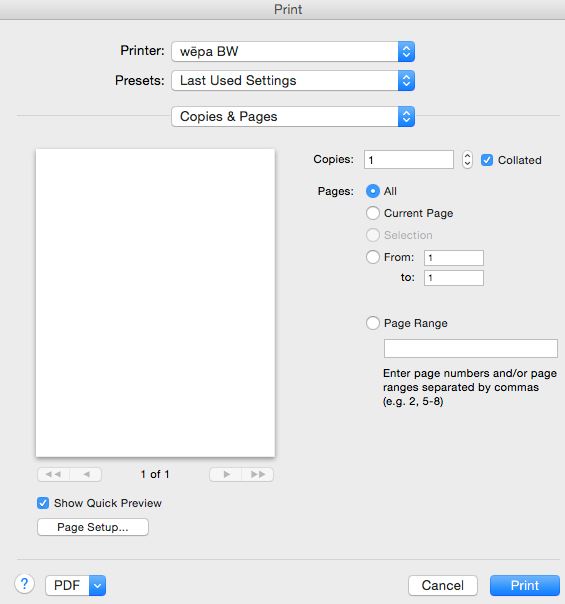
The print settings window will appear with a selected printer. Open the printer drop-down menu and choose one of the available wēpa printers.

wēpa BW
Prints black and white on the front of each page only.
wēpa BW Two-Sided
Prints black and white on the front and back of each page.
wēpa Color
Prints color on the front of each page only.
wēpa Color Two-Sided
Prints color on the front and back of each page.
Each printer option may have a different print cost per piece of paper. Contact wēpa support at help@wepanow.com, chat with support, or call 1-800-675-7639 for print costs at a specific institution.

Windows Print App: Print Windows

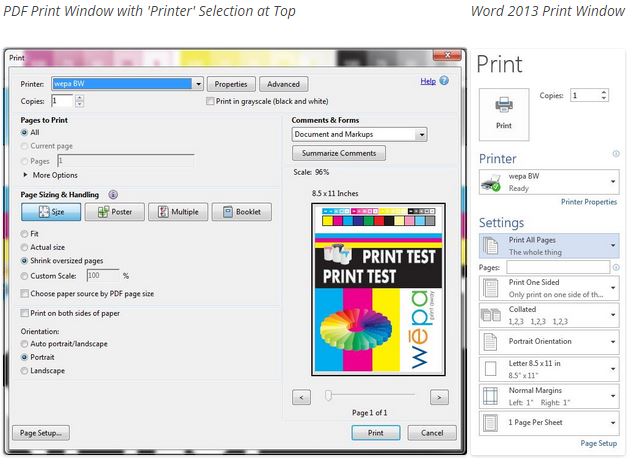
Windows PDF and Word print window examples

Mac Print App: Print Windows

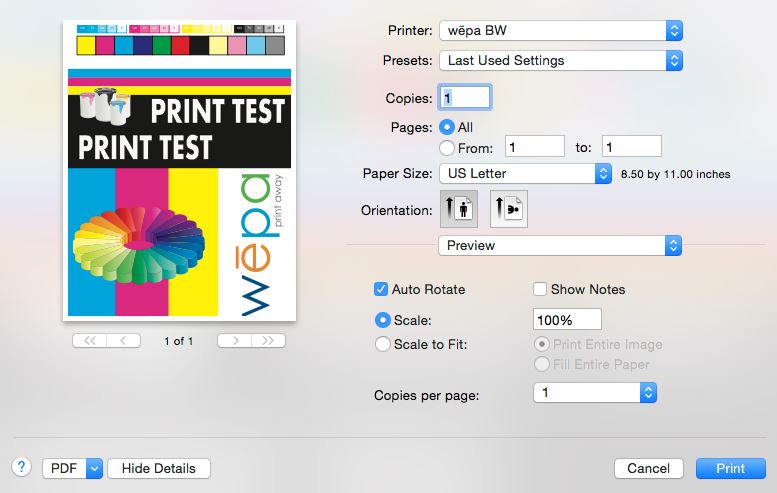
PDF print window with printer selection at the top:

Mac PDF print window with printer selection at top

Word print window:

Mac Word print window

Format Settings

Choose any needed print format settings, such as printing multiple pages per sheet, page range, copies, or orientation. Review the print preview before uploading to confirm the document looks correct.

Page size note: Select Page Setup and confirm the page size is set to Letter 8.5 x 11 in. If the page size is set to something else, the document may not upload or may not appear at the print station.

After choosing a wēpa printer and confirming the format settings, select Print to upload the document. If using a public or lab computer, enter your username and password when prompted to complete the upload.

Documents Uploaded

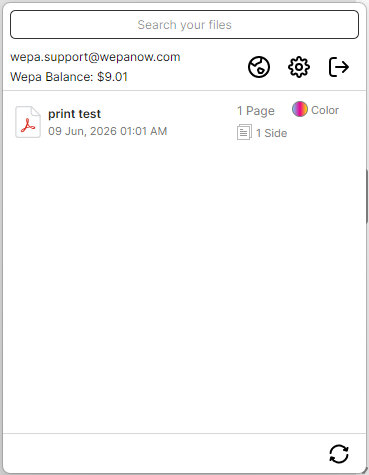
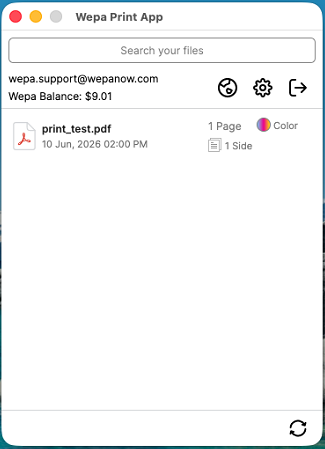
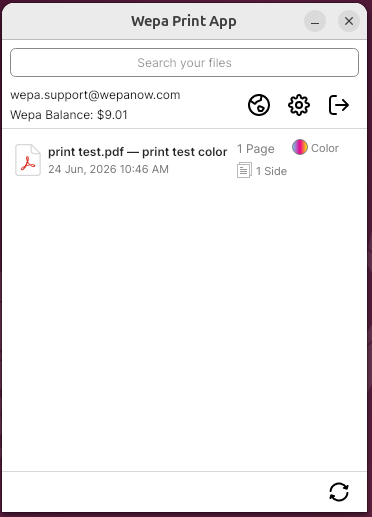
Click the wēpa icon to see the full list of documents uploaded to the wēpa account. The wēpa icon for Windows is located in the lower-right system tray area. For Mac, it is located in the upper-right toolbar area.

Windows Print App – Documents Uploaded

Windows Print App documents uploaded list

Mac Print App – Documents Uploaded

Mac Print App documents uploaded list

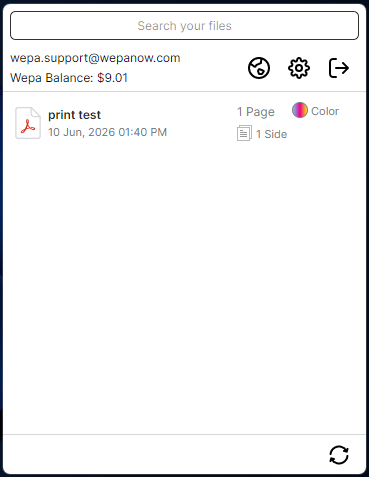
Linux Print App – Documents Uploaded

Linux Print App documents uploaded list

Submit Crash Report

If you encounter issues uploading a document, select the print app icon, open settings, and choose Submit Crash Report. This helps wēpa support review logs and troubleshoot the issue.

Windows Print App – Submit Crash Report

Windows Print App Submit Crash Report menu option

Mac Print App – Submit Crash Report

Mac Print App Submit Crash Report menu option

Linux Print App – Submit Crash Report

Linux Print App Submit Crash Report menu option
If the Submit Crash Report option is unavailable, use the troubleshooting log instructions below:

Linux Print App

  • The Linux Print App is the most flexible way to print from a Linux computer.
  • Print from any software by choosing File > Print and selecting a wēpa printer.
  • The Linux Print App is currently available as a Debian package for x64 and ARM64 systems.

Quick Start: Download the Linux Print App Debian package that matches your system architecture and install it.

Download Linux Print App for deb (x64) Download Linux Print App for deb (arm64)

Website Download

Go to wepanow.com/software to download the latest version.

Latest Version: 2026.6.7

Choose the Linux Debian package that matches the computer architecture. The Debian package filename will look similar to: wepa_print_app-linux-<arch>-<version>.deb

Installation

Install the Debian package

Open Terminal in the folder where the Debian package was downloaded, then run:

sudo apt install ./wepa_print_app-linux-<arch>-<version>.deb
Replace <arch> and <version> with the exact package filename that was downloaded.

What the package installs

The Linux package installs the application, creates the required folders, and adds the wēpa CUPS printer queues.

Item Linux Location / Name
Package name wepa-lpa
Main binary /usr/lib/wepa-lpa/wepa-lpa
Command symlink /usr/bin/wepa-lpa
Crash report utility /usr/lib/wepa-lpa/CrashReporter
Shared settings file /var/lib/Wepa/Settings.xml
Log folder /var/log/com.wepa.printapp/
Spool folder /var/spool/WepaQueue/<username>/

Linux app shortcuts

After installation, the system will show shortcuts for the Wepa Print App and Wepa Print App Utility. The utility is used to collect and send logs when troubleshooting issues.

Linux Wepa Print App shortcut Linux Wepa Print App Utility shortcut

Choose personal or shared / public setup

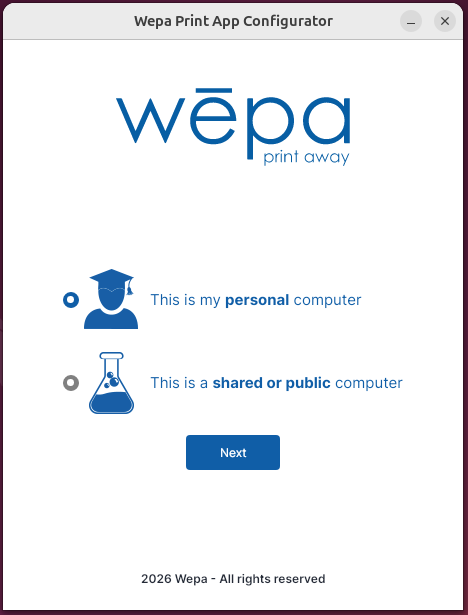
When the application launches, select This is my personal computer if installing on a personal Linux computer or This is a shared or public computer if installing on a shared or public computer, such as a lab environment. Click Next to proceed.

Important: If you choose shared or public, this choice becomes locked and cannot be changed to the personal version. You must uninstall and reinstall if you decide you want the personal version.
Linux Print App personal or shared public computer selection screen

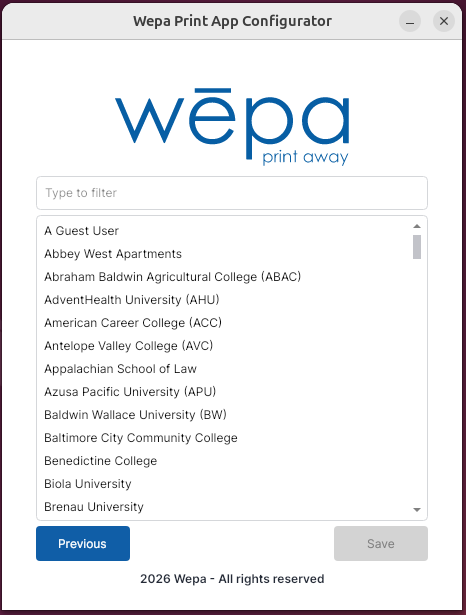
Select your school or institution

Select your school or institution. If you are not affiliated with one, choose A Guest User.

Linux Print App school or institution selection screen

Lab / Public Options

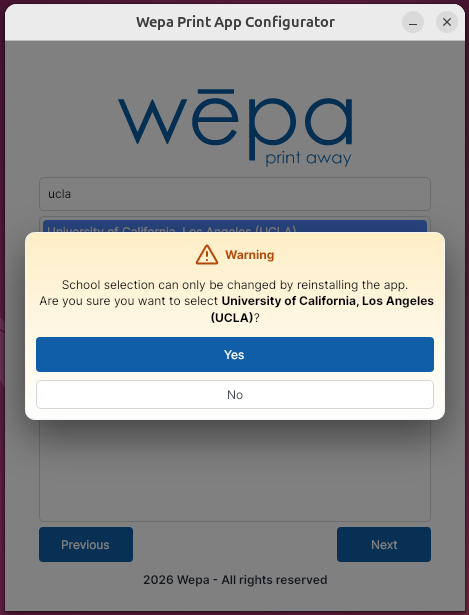
Confirm shared / public setup

After you choose the school, you are notified that this choice can only be changed by uninstalling and reinstalling the application.

Linux Print App warning that school selection can only be changed by reinstalling

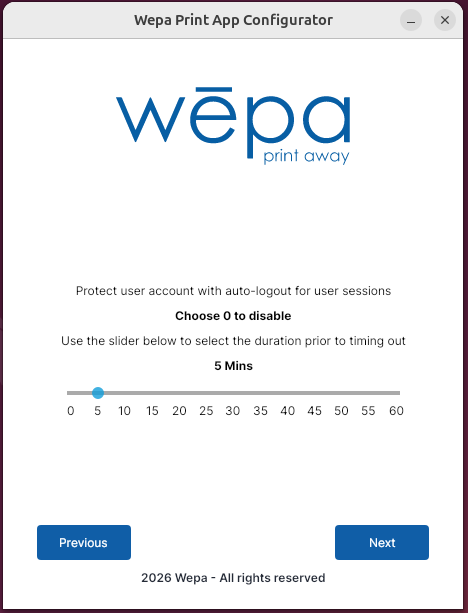
Configure session timeout

Set a session timeout value. The Session Timeout controls when users are prompted to log out or stay signed in. Set the value to 0 to disable the session timeout when users log in and out of Linux with their own accounts.

Linux Print App session timeout setting

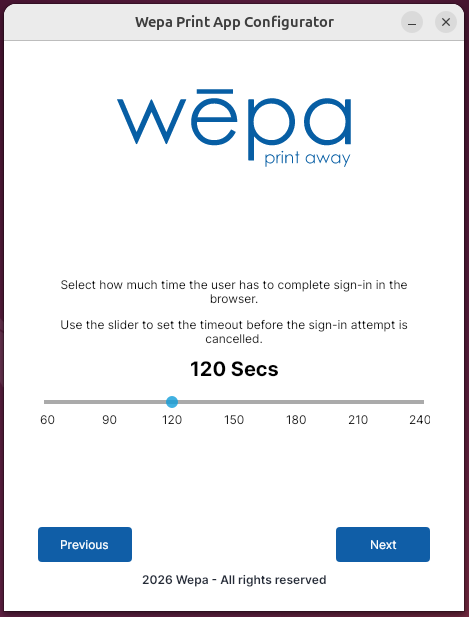
Configure Single Sign-On timeout

For Single Sign-On schools, configure the Single Sign On (SSO) Timeout. This controls how long users have to complete browser sign-in before the attempt is canceled.

Linux Print App SSO browser sign-in timeout setting

Configure force timeout

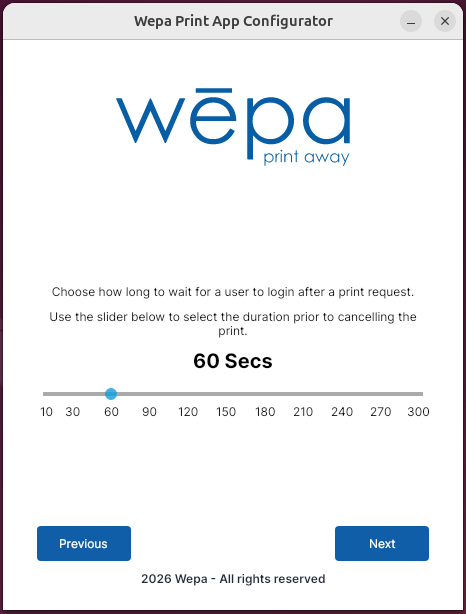
The Force Timeout controls how long the Print App waits for a user to log in or choose guest printing after a print request starts.

Linux Print App force timeout setting

Configure logout prompt

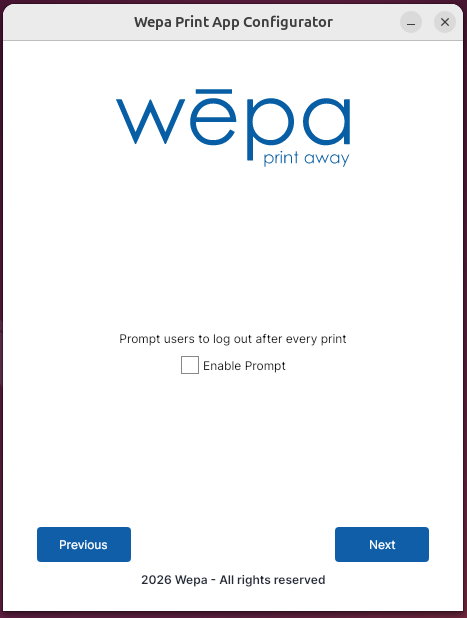
Enable Logout Prompt prompts users to sign out after successfully uploading a print job, which helps protect account security on shared devices.

Linux Print App enable logout prompt setting

Configure guest printing

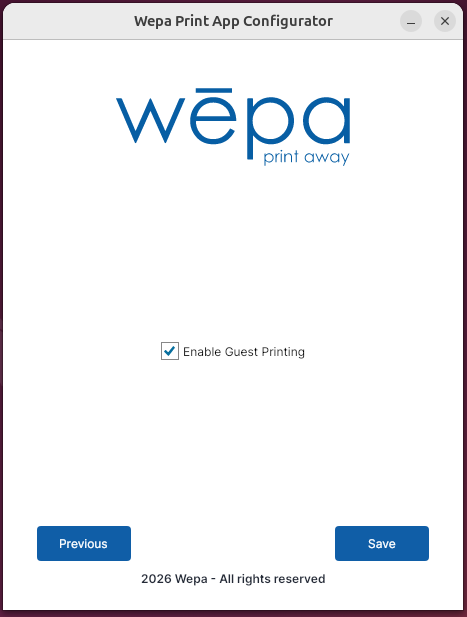
Allow Guest Printing lets users submit print jobs without signing in or creating an account. A release code will be provided so the user can release the document at a print station.

Linux Print App allow guest printing setting

Login screen

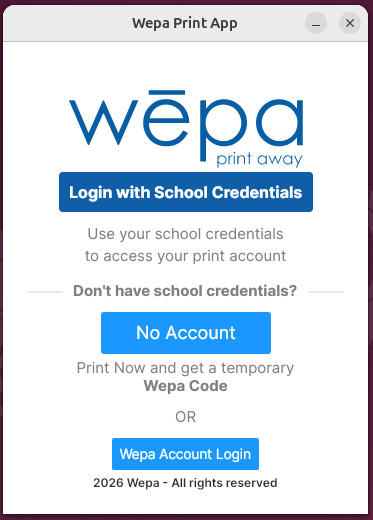
For Single Sign-On schools, users will see a Login with School Credentials button. Selecting this option launches an external browser so users can sign in on the school’s login page. If Guest Printing is enabled, select No Account to print without signing in and receive a wēpa code.

Linux Print App SSO login screen with school credentials and guest printing options

How to Print

From any software that can print, choose File > Print, select a wēpa printer from the drop-down menu, and select Print. If you are not already signed in, a login prompt will appear.

CUPS printer queues

The Linux package installs the following wēpa CUPS printer queues:

  • wepa_BW — black and white
  • wepa_BW_Two_Sided — black and white, two-sided
  • wepa_Color — color
  • wepa_Color_Two_Sided — color, two-sided
The default installed printer is wepa_BW.

Upload processing

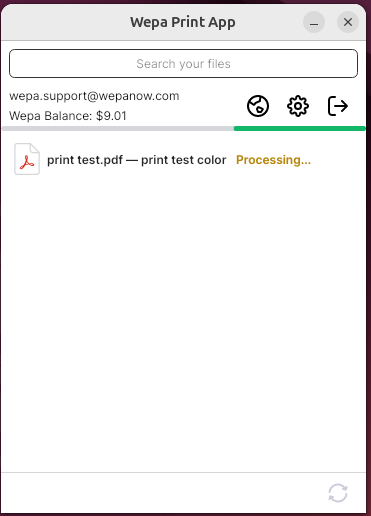
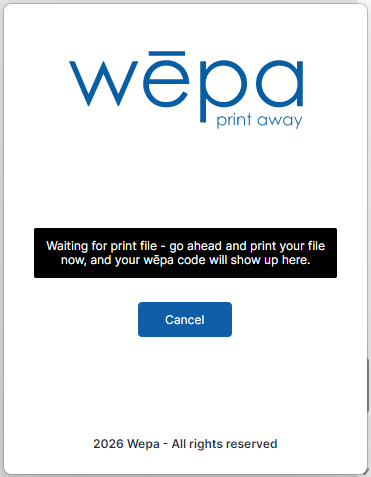
The Linux Print App will show the print job while it is uploading or processing.

Linux Print App showing a print job uploading

Guest release code

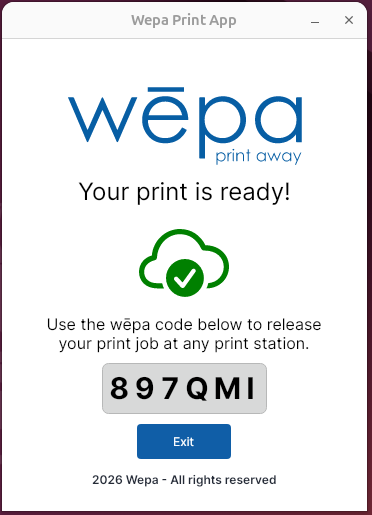
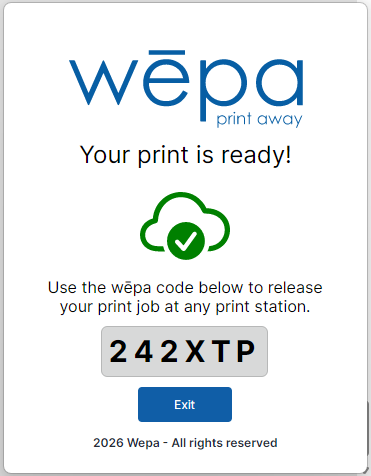
If guest printing is used, the Guest Printing window will process and upload the document, then provide a wēpa code to use at any print station.

Linux Print App guest print ready screen showing a wēpa code

Lab logout prompts

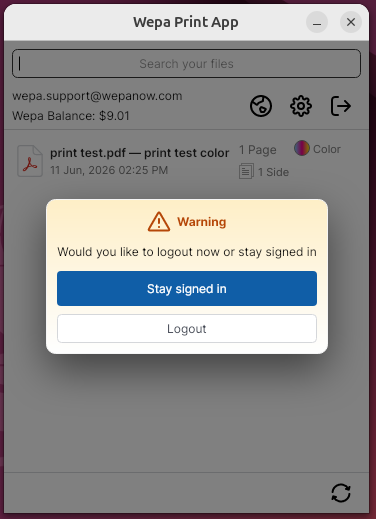
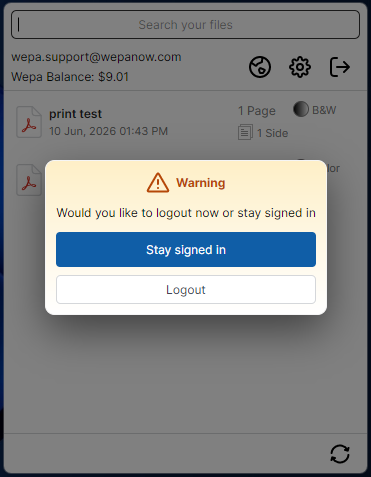
Lab Only: If prompt to logout after every print is enabled, a window will appear requesting the user to stay signed in or log out after each upload. Select Logout if finished printing to ensure the next user will not print to your wēpa account, or select Stay signed in if continuing to print.

Linux Print App logout after upload prompt

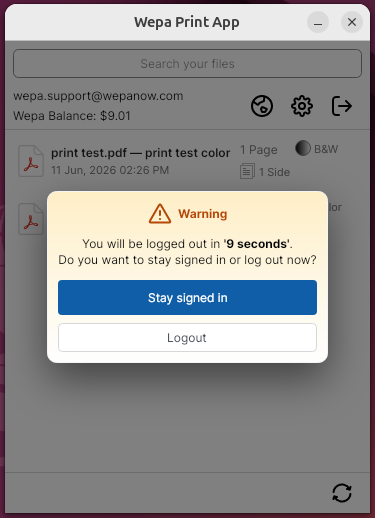
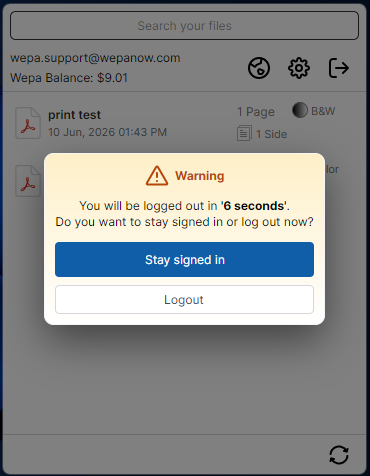
Lab Only: If the session timeout is enabled, a window will appear requesting the user to stay signed in or log out after the configured amount of time has passed without a print.

Linux Print App session timeout logout prompt

Settings and Troubleshooting

Submit Crash Report

Select the settings option to view additional tools and support options. Click Submit Crash Report to email necessary logs to wēpa support. If the option is unavailable, use the manual log locations below.

Linux Print App settings and support options

Wepa Print App Utility

The Wepa Print App Utility can also be used to collect and send logs if the main app cannot submit the crash report.

Linux Wepa Print App Utility status and collect logs screen

Send logs

A Send Logs message will appear after the logs are collected. Select OK to open your email app automatically with the logs attached.

Linux Wepa Print App Utility send logs dialog
Include a brief description of the issue before sending the email so wēpa support can better understand what happened.

Linux File Locations

The Linux Print App uses shared system locations for settings, logs, and spool files.

Item Linux Location Notes
Settings file /var/lib/Wepa/Settings.xml The shared lab configuration file. For deployment, install or copy the lab configuration to this path after installing the package.
Print app logs /var/log/com.wepa.printapp/ Send PrintApp.log, PrintApp.Secondary.log, wpapdfqueue_log, and any other recent files if present.
Crash logs /var/log/com.wepa.printapp/ Send any recent timestamped .txt crash files from this folder.
Spool files /var/spool/WepaQueue/<username>/ Temporary print app spool location for the Linux user.
The package creates the shared data folder and settings file if they do not already exist.

Uninstalling

To uninstall the Linux Print App on Debian-based systems, use apt remove or apt purge.

Remove the application

Use remove to uninstall the application package while leaving related configuration files behind.

sudo apt remove wepa-lpa

Purge the application and package configuration

Use purge when you want to remove the application package and package-managed configuration files.

sudo apt purge wepa-lpa

Deploy wepa Print App for Windows to multiple public computers

wēpa institutional customers can deploy the wēpa Print App for Windows to multiple public computers using standard deployment methods such as Group Policy, SCCM, Microsoft Intune, or silent command line installation.

Use the Wepa Lab Configurator to create an MST transform file that defines the desired school, login, timeout, guest printing, and printer configuration options.

  • Install the Wepa Lab Configurator.
  • Use the Wepa Lab Configurator to create one or more MST files for your desired configuration.
  • Deploy the MSI using the generated MST file.

Download Wepa Lab Configurator for Windows

Version and Requirements

Windows Print App Latest Version: 2026.6.7

Download Windows Print App x64

Should I update my driver?
If you are using a version below 2026.6.7, we recommend updating to our latest version.

Change Log

v.2026.6.7: New Universal Print App released, using a shared wēpa Print App codebase across Windows, macOS, and Linux. Improvements include:

  • Updated user interface: New modern design and style.
  • Color-coded queue icons: Print jobs in the queue use color-coded icons to indicate file type.
  • Standard Windows directories: Installs in standard Windows directories for seamless compatibility. For example, the main app is installed in Program Files.
  • Multi-user Windows environment support: Improved support for shared computers and virtual desktop environments where multiple Windows users may use the same machine. User-specific app data is handled per Windows user, while shared installation files are stored in standard machine-wide Windows locations.
  • Configurable SSO timeout: The timeout for Single Sign-On browser login can be configured during setup.

Install the Wepa Lab Configurator

Download and install the Wepa Lab Configurator on the administrator computer that will be used to create the MST files.

Download Wepa Lab Configurator for Windows

Open the Wepa Lab Configurator

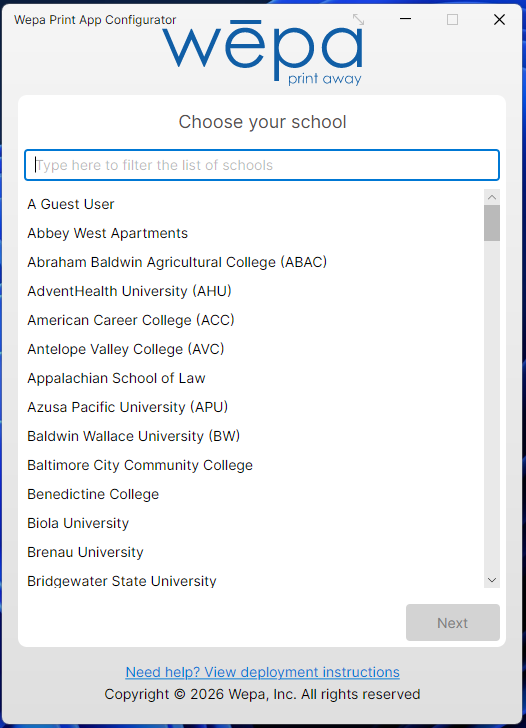
Launch the Wepa Lab Configurator and choose your school or institution. Use the search box to narrow the list.

Wepa Lab Configurator school selection screen

Create MST Files

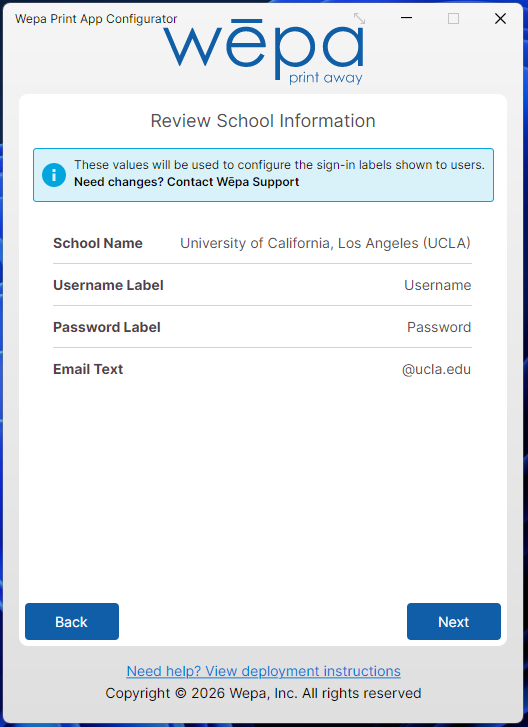
Review retrieved school configuration

The Wepa Lab Configurator retrieves the necessary configuration items for your institution. Contact your wēpa Project Manager or help@wepanow.com if any of these values need to change.

Wepa Lab Configurator school configuration screen

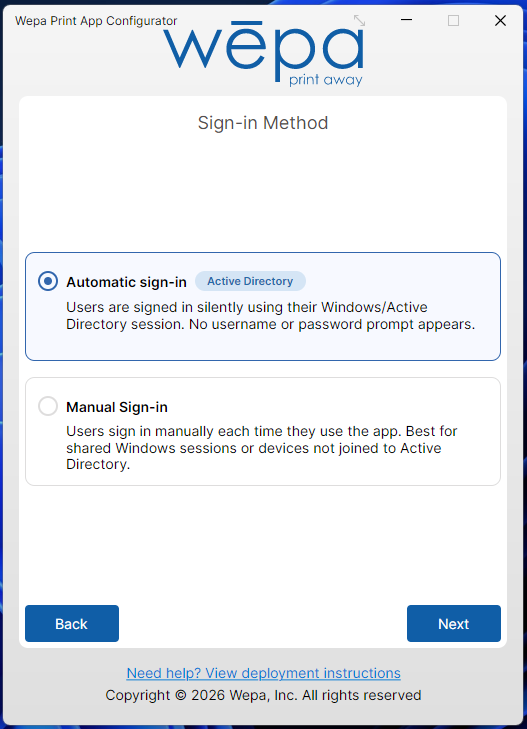
Configure Windows username / Active Directory login

If your school has approved Active Directory login, this screen lets you choose whether users are signed in automatically with their Windows / Active Directory session or prompted to sign in manually.

Select Manual Sign-in to configure the additional lab settings shown in the next steps. If Active Directory login is not available for your school, manual sign-in is selected automatically and the lab settings configuration appears next.

If Automatic sign-in is selected, the default printer selection appears next. The additional lab sign-in settings are skipped because Active Directory login removes the need for those manual sign-in options.

Wepa Lab Configurator Windows username and Active Directory login configuration

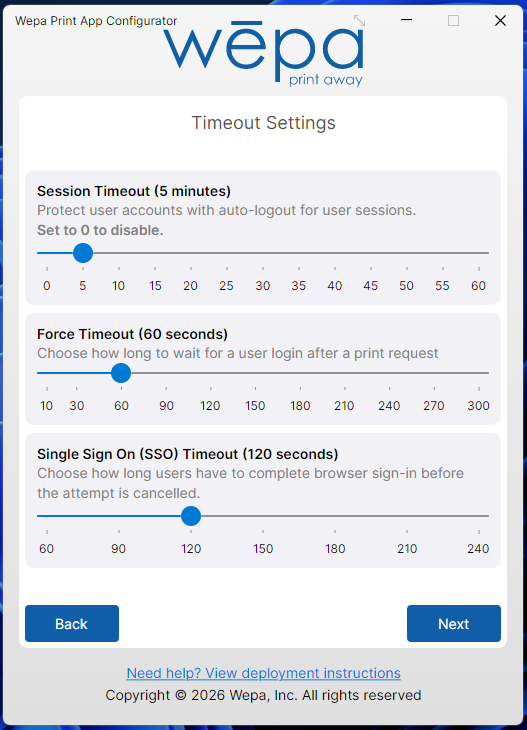
Configure manual sign-in timeout settings

Configure timeout settings for manual sign-in. The Session Timeout controls when users are prompted to log out or stay signed in. Set the Session Timeout to 0 to disable it when users log in and out of Windows with their own accounts.

The Force Timeout controls how long the Print App waits for a user to log in or choose guest printing after a print request starts.

If your school is set up with Single Sign-On, a configurable Single Sign On (SSO) Timeout is available as well.

Wepa Lab Configurator manual sign-in timeout settings

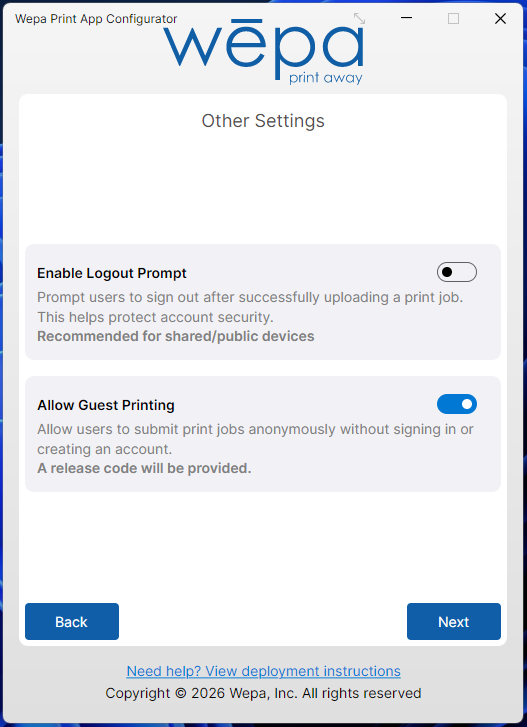
Configure other manual sign-in options

Configure the remaining manual sign-in options for shared or public computers. Enable Logout Prompt prompts users to sign out after successfully uploading a print job, which helps protect account security on shared devices.

Allow Guest Printing lets users submit print jobs without signing in or creating an account. A release code will be provided so the user can release the document at a print station.

Wepa Lab Configurator manual sign-in options

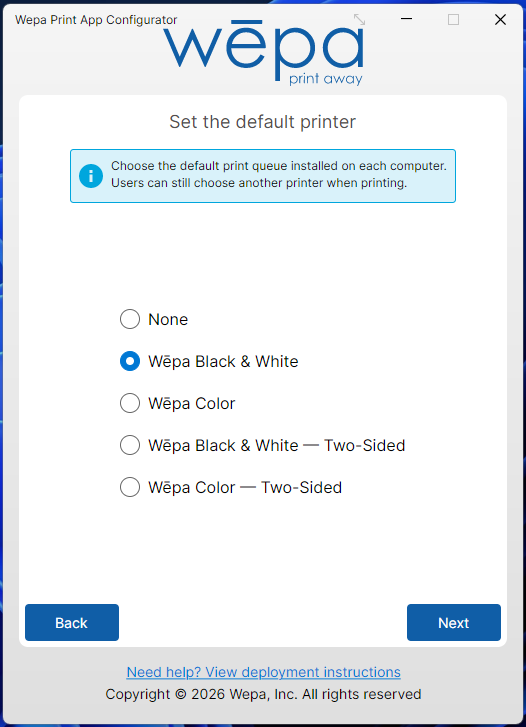
Configure default printer

Choose which wēpa printer will be selected by default in the application. Users can still change to a different wēpa printer when printing. For Default Printer, select None to leave the existing default printer unchanged.

Note: Windows can sometimes change or alter the default printer after installation. Confirm your institution’s preferred default-printer behavior during deployment testing.
Wepa Lab Configurator default printer configuration

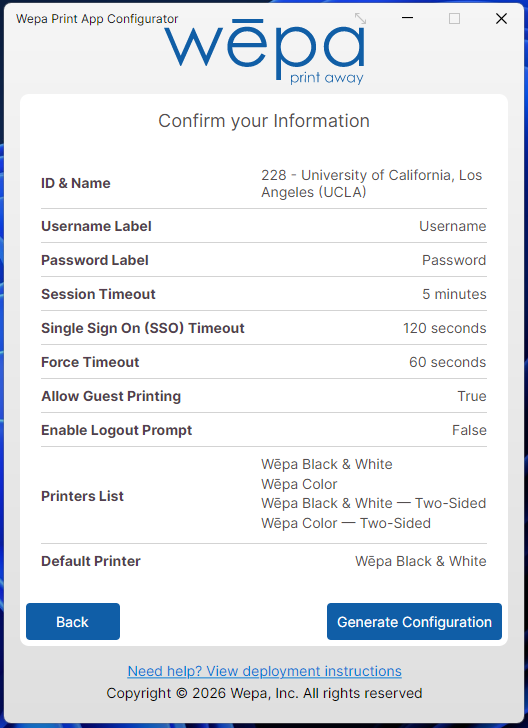
Confirm selected options

Review the selected configuration options. If the options are correct, select Generate Configuration. If changes are needed, select Back and update the configuration.

Wepa Lab Configurator confirmation screen

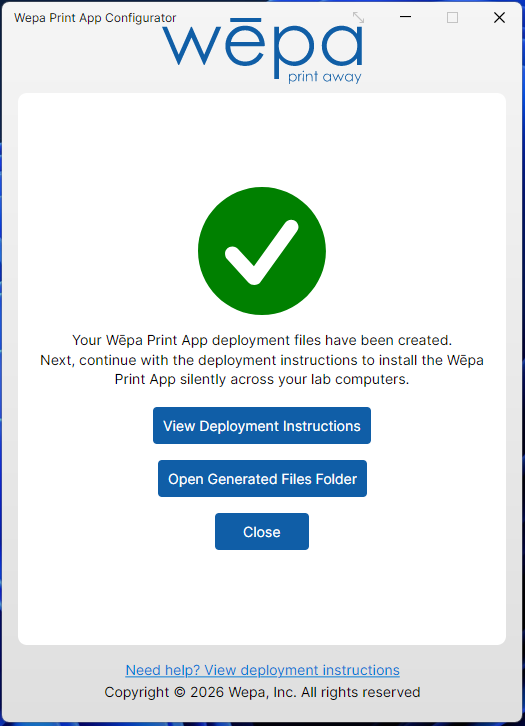
Review the final generated view

After the MST file is generated, the Wepa Lab Configurator will show the final result.

  • View Deployment Instructions opens this support page with deployment instructions.
  • Open Generated Files Folder opens the folder where the generated MST file is located.
  • Close closes the Wepa Lab Configurator.
Wepa Lab Configurator final generated view

Generated Files

Open the generated files folder

When the MST file is generated, Windows Explorer opens to the generated files location. The MST file is stored inside the folder named for the selected school.

The PrintApp.log file shown in this location is created by the Wepa Lab Configurator for support and troubleshooting purposes.

Documents folder with generated MST files

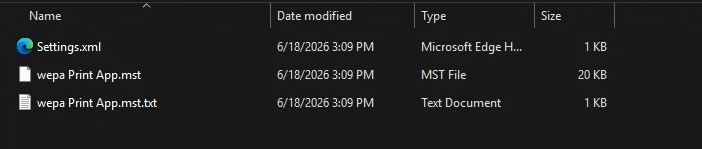
Review the school folder with MST files

Use the generated MST file in the deployment command or deployment tool in the next steps.

The .txt file provides an easy way to review the settings included in the MST file. The Settings.xml file is an example of the configuration that will be applied during deployment.

For existing deployments using the new wēpa Print App v.2026.6.7 or newer, the Settings.xml file can also be copied to C:\ProgramData\Wepa to replace the existing Settings.xml file. The wēpa Print App must be closed and restarted before it will load the new Settings.xml file.

Generated files folder with MSI, MST, Settings XML, and settings text file

How to Deploy the Application

Note: Use the Wepa Lab Configurator to make a new MST file any time that you upgrade to a new version.

You can deploy the wēpa Print App from an administrator command line with this command:

msiexec /i "wepa Print App.msi" /qn TRANSFORMS="wepa Print App.mst"
In the command above, replace wepa Print App.msi with the exact name of the MSI file being deployed. The generated MST filename should also match the MST file you are using.

You can also deploy the MSI and MST using other methods that work with MST files, such as Group Policy, SCCM, or Microsoft Intune.

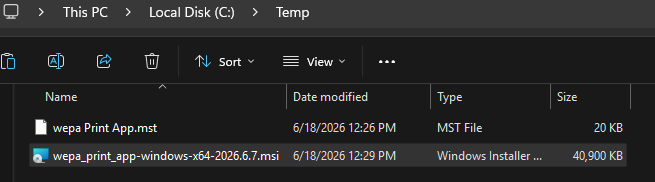
Example: MSI build folder with MST file

Place the MSI and generated MST file in the same folder before running the deployment command. In this example, both files are located in the C:\Temp folder.

C Temp folder containing the MSI and generated MST file

Example: Administrator command line deployment

Run the deployment command from an administrator command prompt, or use the equivalent command in your deployment system.

The optional /L*v “C:\Temp\upa-install.log” parameter creates a detailed installation log file. This can be helpful for support and troubleshooting if the silent installation does not complete as expected.

Administrator command prompt running msiexec deployment command

How to Silently Uninstall the Application

You can silently remove the wēpa Print App from an administrator command line with this command:

msiexec /i "wepa Print App.msi" /qn REMOVE=ALL

Windows Print App Troubleshooting Logs

If the Windows Print App encounters problems, submit print app logs first when possible. Logs help wēpa support review upload, login, or print app issues.

If the built-in log collection option does not work, use the manual log retrieval section below.

Submit Print App Logs

Open the Windows Print App settings view, then select Submit Crash Report to collect support logs.
Windows Print App settings screen with Submit Crash Report button

The log collection view will appear. Select Collect & send logs to collect the necessary log files.

Windows Print App log collection view with Collect and send logs option

A Send Logs message will appear after the logs are collected. Select OK to open your email app automatically with the logs attached.

Windows Print App Send Logs message with instructions
Include a brief description of the issue before sending the email so wēpa support can better understand what happened.
If an email window does not open, the utility will open a folder on your computer that contains the generated log zip file. Create a new email to help@wepanow.com, attach WPA_Install_and_PrintAppCrashLogs.zip from that folder, and include a brief description of the issue.

Manual Log Retrieval

If you cannot submit logs from the Windows Print App, manually retrieve the files below and send them to help@wepanow.com with a brief description of the issue.

Log Type Windows Location What to Send
Main log %LocalAppData%\Wepa\logs\PrintApp.log Send PrintApp.log. If present, also send PrintApp.Secondary.log. If the issue happened on a previous day, also send recent archived files such as PrintApp.*.log or PrintApp.Secondary.*.log.
Crash logs %LocalAppData%\Wepa\Crash Log\ Send any recent crash log text files from this folder.
Install log C:\ProgramData\Wepa\WPA_Install_Log.log Send this file if the issue is related to installation, upgrade, uninstall, or app configuration.
Generated zip from utility C:\ProgramData\Wepa\WPA_Install_and_PrintAppCrashLogs.zip This zip file is created after the log collection utility runs. Send this file if the utility opens the folder but does not open an email window.
App settings C:\ProgramData\Wepa\Settings.xml Send this file if the issue appears related to app configuration, login behavior, timeout settings, guest printing, or default printer settings.
Open the main log folder

Press Windows key + R, paste the following path, and press Enter:

%LocalAppData%\Wepa\logs

Attach PrintApp.log to your email. If PrintApp.Secondary.log is present, attach that file as well. If the issue happened on a previous day, also attach recent archived files such as PrintApp.*.log or PrintApp.Secondary.*.log.

Open the crash log folder

Press Windows key + R, paste the following path, and press Enter:

%LocalAppData%\Wepa\Crash Log

Attach any recent crash log text files from this folder. Crash logs are usually individual .txt files with a timestamp in the filename.

Open the install log location

Press Windows key + R, paste the following path, and press Enter:

C:\ProgramData\Wepa

Attach WPA_Install_Log.log if the issue is related to installation, upgrade, uninstall, or app configuration. If support requests app configuration details, attach Settings.xml from this folder as well.

Open the generated zip location

The generated zip file is created only after the log collection utility runs. If the utility opens a folder but does not open an email window, attach the zip file from:
C:\ProgramData\Wepa\WPA_Install_and_PrintAppCrashLogs.zip

Attach WPA_Install_and_PrintAppCrashLogs.zip to a new email and send it to help@wepanow.com with a brief description of the issue.
Tip: If you do not see the ProgramData folder, it may be hidden in Windows. You can still open it directly by pasting C:\ProgramData\Wepa into File Explorer or the Run dialog.

Log Notes

  • The main log file is PrintApp.log.
  • If a second instance of the app is running, PrintApp.Secondary.log may also be present.
  • Logs are archived daily, with the last 5 archives kept. If the issue happened on a previous day, include recent archived files such as PrintApp.*.log or PrintApp.Secondary.*.log.
  • Crash logs are written as individual .txt files with a timestamp in the filename when unhandled exceptions occur.
  • The generated crash report zip, WPA_Install_and_PrintAppCrashLogs.zip, is created in C:\ProgramData\Wepa after the log collection utility runs.
  • Settings.xml may be useful for troubleshooting app configuration, login behavior, timeout settings, guest printing, or default printer settings.
Send the logs to help@wepanow.com and include what happened, the approximate time the issue occurred, and the document name or file type if the issue happened during upload.

Windows Print App

  • The Windows Print App is the most flexible way to print from Windows.
  • Print from any software by choosing File > Print and selecting a wēpa printer.
  • Works with Windows computers and Surface Pro tablets.
  • For Windows Surface RT or Windows Surface 2 tablets, please use Email-To-Print or Web Upload.
  • If you want to deploy this to multiple public computers, click here.

Quick Start: Download the Windows Print App installer that matches your computer architecture and run it.

Download Windows Print App x64 Download Windows Print App x86

Website Download

Go to wepanow.com/software to download the latest version.

Latest Version: 2026.6.7

Installation

Open the .msi file to begin installation.

Software Requirement: .NET 4.7.1 or greater framework. A prompt will appear to install it if it is not already present.
32-bit Software Requirement: Microsoft VC++ 2017 or greater runtime package. Click here to download and install.

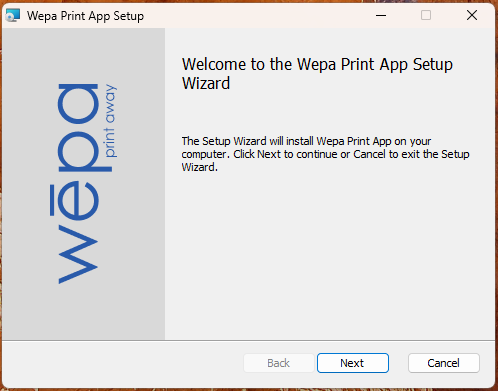
Press Next and proceed through the installation steps.

Windows Print App installer welcome screen

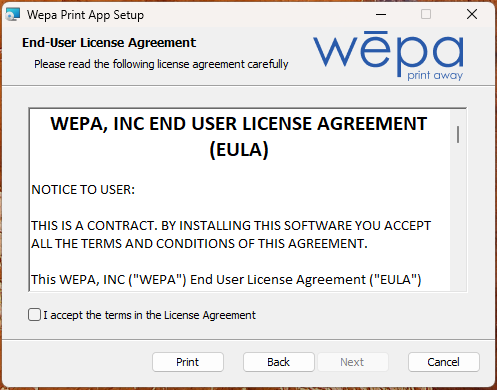
Accept the terms of the license agreement and choose Next.

Windows Print App license agreement screen

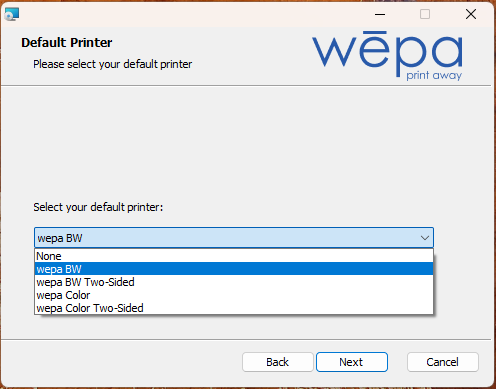
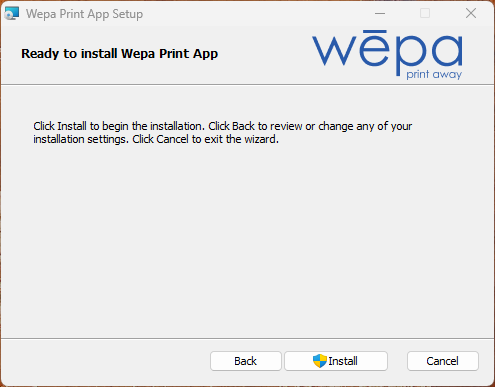
Select the default printer from the drop-down menu, then choose Install. Two-sided printers will print documents on two sides by default. Choose None to retain your current default printer.

Windows Print App default printer selection screen Windows Print App installation options screen

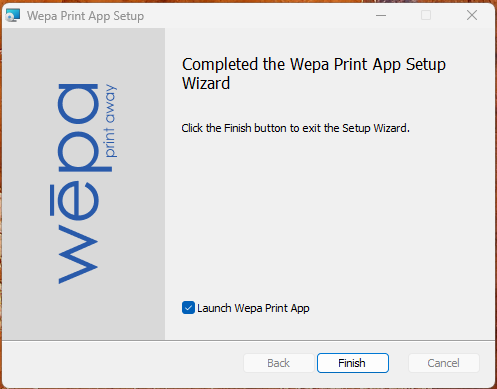
After the installation completes, press Finish to launch the application.

Important: You must launch the app the first time to complete the configuration, and this needs to be done with administrative rights.
Windows Print App installation completed screen

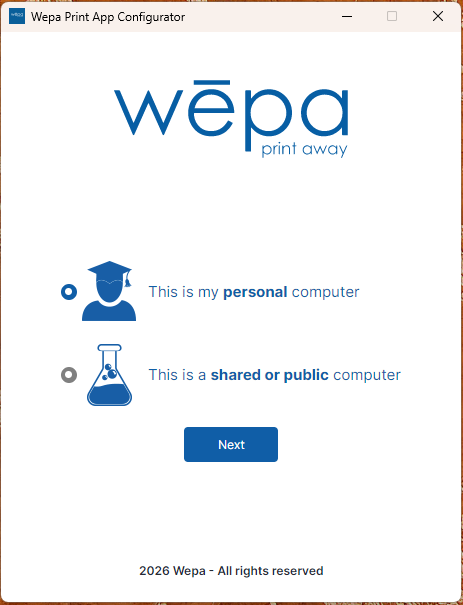
When the application launches, select personal if installing on a personal computer or shared or public if installing on a shared or public computer, such as a lab environment. Click Next to proceed.

Important: If you choose shared or public, this choice becomes locked and cannot be changed to the personal version. You must uninstall and reinstall if you decide you want the personal version.
Windows Print App personal or shared public computer selection screen

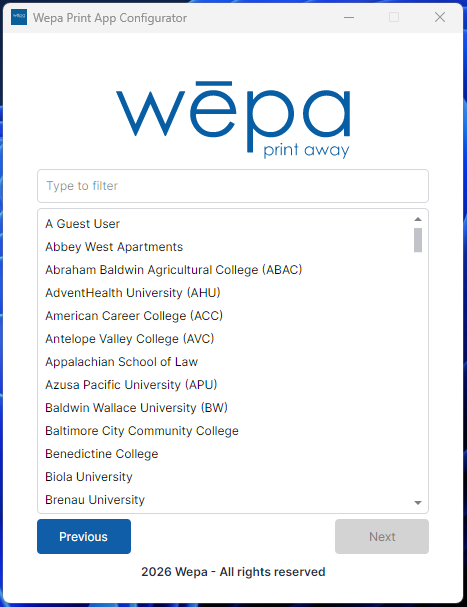
Select your school or institution. If you are not affiliated with one, choose A Guest User.

Windows Print App school or institution selection screen

Lab / Public Options

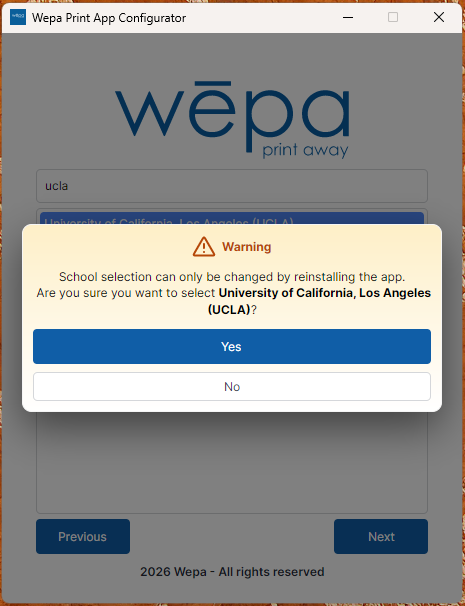
After you choose the school, you are notified that this choice can only be changed by uninstalling and reinstalling the application.

Windows Print App warning that the school selection can only be changed by reinstalling

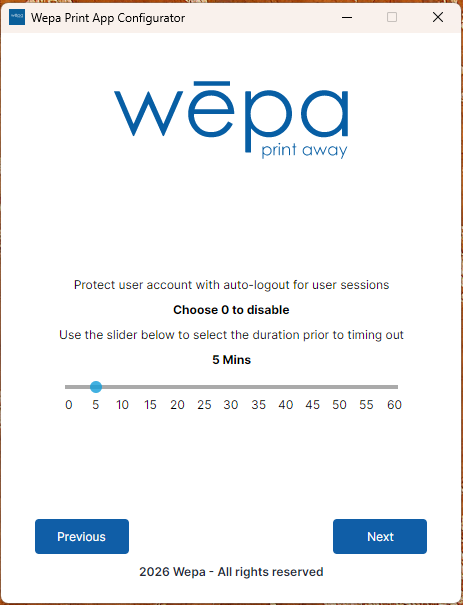
Set a session timeout value. Users will be automatically logged out of the application after a set amount of time. This choice is appropriate when users do not log in and out of Windows with their own account. Set the value to 0 to disable the session timeout.

Windows Print App session timeout setting

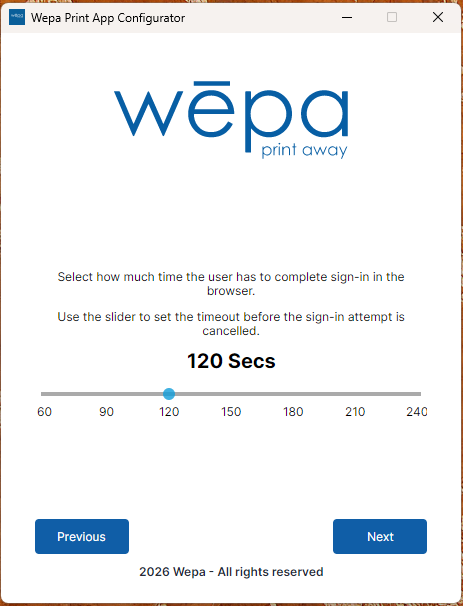
For Single Sign-On (SSO) schools, select the timeout for the user to complete sign-in in the browser.

Windows Print App SSO browser sign-in timeout setting

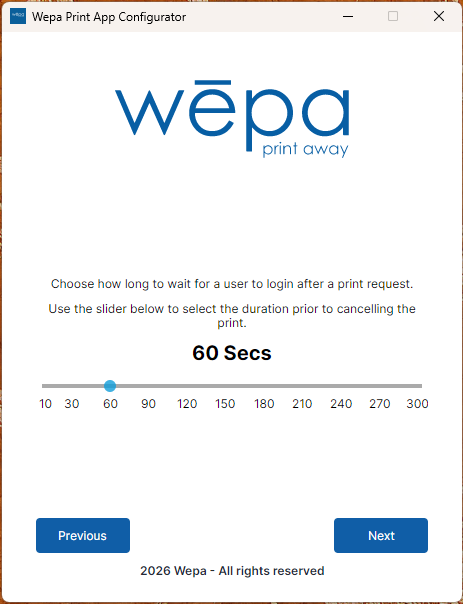
Choose how long to wait for a user to log in after a print request. If there is no login, the print attempt will be canceled after this amount of time.

Windows Print App login wait timeout setting

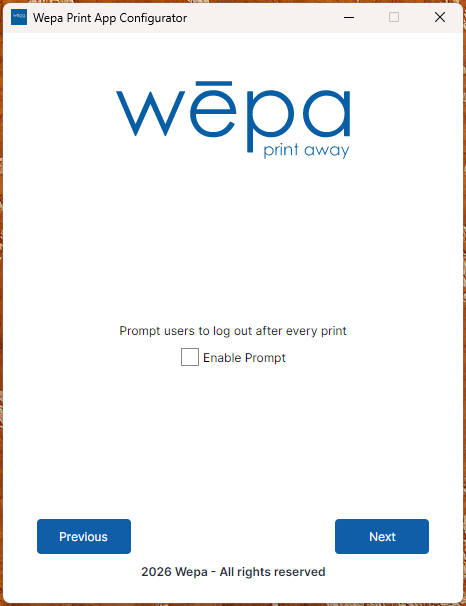
Choose whether to prompt users to log out after every print. This choice is appropriate when users do not log in and out of Windows with their own account.

Windows Print App prompt users to log out after every print setting

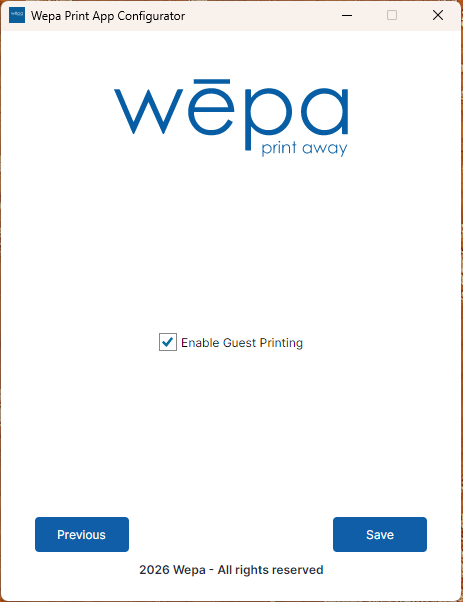
Select whether the Guest Printing option is available. This option enables the guest printing button on the login screen. Visitors can use guest printing to upload a document and receive a six-character wēpa code that can be used at any print station.

Windows Print App enable guest printing setting
Reminder: These choices become locked and cannot be changed. You must uninstall and reinstall to choose a different school or different options.

Choose Save to finish the setup process. The login screen may look different depending on your school’s sign-in configuration.

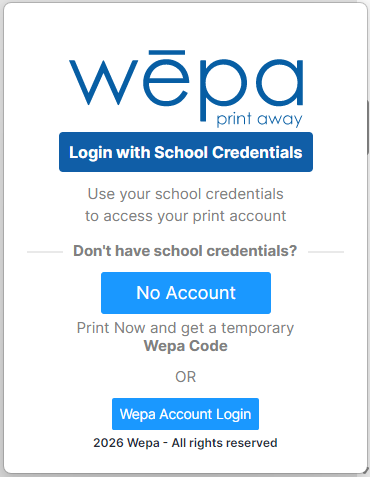
For Single Sign-On (SSO) schools, users will see a Login with School Credentials button. Selecting this option launches an external browser so users can sign in on the school’s login page. If Guest Printing is enabled, select No Account to print without signing in and receive a wēpa code.

Windows Print App SSO login screen with school credentials option

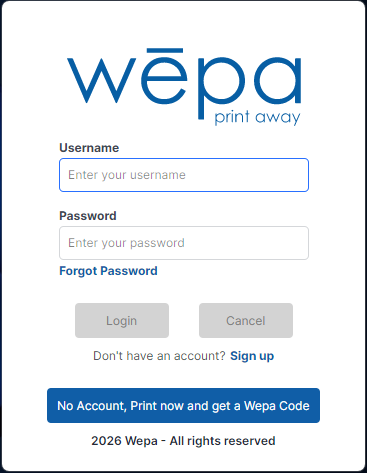
For non-SSO schools, the login screen will request a username and password. If Guest Printing is enabled, select No Account, Print now and get a Wepa Code to print without signing in.

Windows Print App username and password login screen with guest printing option

How to Print

From any software that can print, choose File > Print, select a wēpa printer from the drop-down menu, and select Print. If you are not already signed in, a login prompt will appear.

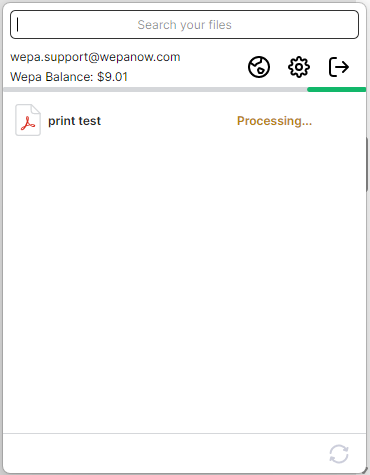
The Print App window will launch and show that the print job is processing.

Windows Print App print job processing

The print job will be shown as ready if the upload was successful. The app will show document details, such as the number of pages and selected print options.

Windows Print App showing a document ready to print

Select the wēpa icon to view uploaded files. Remember to log in at the print station to see all of your documents. You do not have to use release codes if you have an account.

Windows Print App documents uploaded list

Lab Only: If prompt to logout after every print is enabled, a window will appear requesting the user to stay signed in or log out after each upload. Select Logout if finished printing to ensure the next user will not print to your wēpa account, or select Stay signed in if continuing to print.

Windows Print App logout after upload prompt

Lab Only: If the session timeout is enabled, a window will appear requesting the user to stay signed in or log out after the configured amount of time has passed without a print.

Windows Print App session timeout logout prompt

Settings and Troubleshooting

Select the settings option to view additional tools and support options. Click Submit Crash Report to email necessary logs to wēpa support at help@wepanow.com. If it is grayed out, select here to manually retrieve these logs.

Windows Print App settings and support options

Guest Printing

If the Guest Printing option was enabled during setup, select No Account, Print now and get a Wepa Code on the login screen to print without signing in.

Select the guest printing option, then send your print job to a wēpa printer.

Windows Print App guest printing start screen

The Guest Printing window will process and upload the document, then provide a wēpa code to use at any print station.

Windows Print App guest print ready screen showing a wēpa code

Uninstalling

Open Control Panel, then click Programs. Scroll down and select wēpa Print App, then click Uninstall in the top menu bar.

Older Print App Versions

Some computers may still show an older version of the Windows Print App. The overall process is similar, but the screens may look different from the examples above.

If your screen does not match this article, update to the latest version from the wēpa software page, or contact your school’s IT support if you are using a lab or public computer.

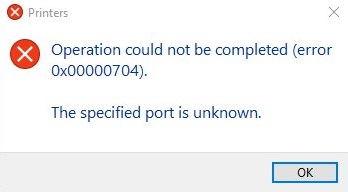
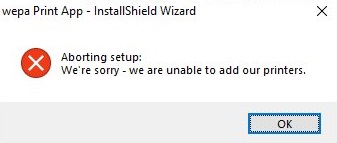
Operation could not be completed error 0x0000074 port is unknown unable to install printers when installing Windows Print App

Some Windows 10 computers encounter an error when installing our Windows Print App driver. The issue is related to permissions and prevents the installation of the Wepa printer port.
This message may appear:


Or this message:


To resolve this issue, please install the Wepa printer port manually and then install the Wepa Print App for Windows.

  1. Download the Wepa port installer here: https://wepanow.com/downloads/WEPAPortInstaller.exe
  2. Run WEPAPortInstaller.exe with admin rights
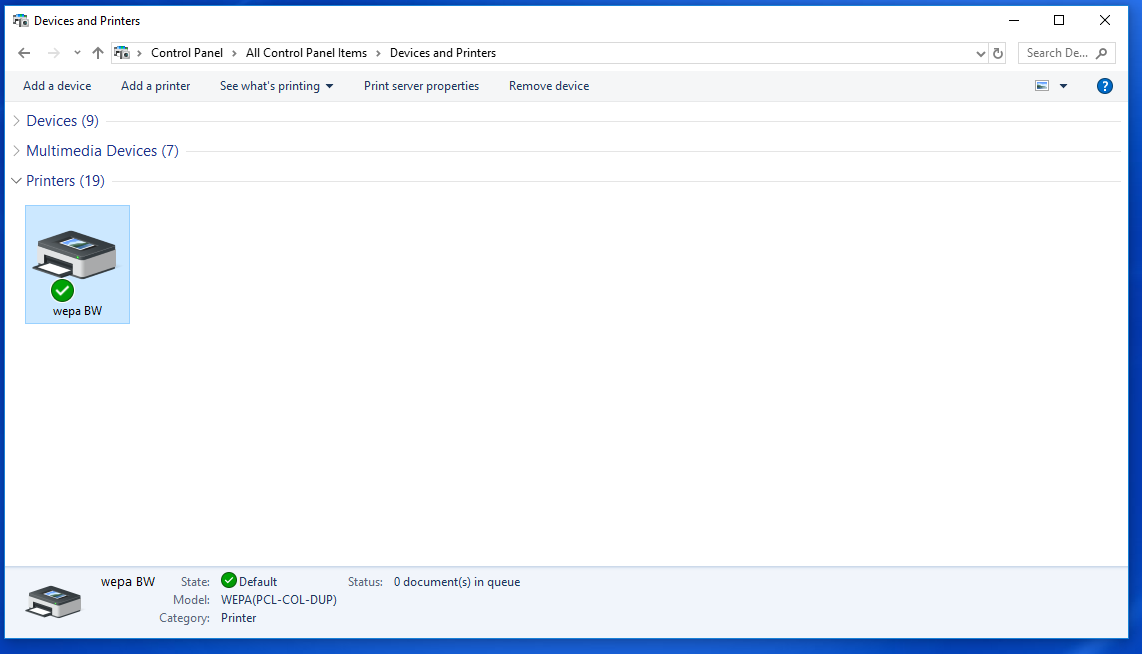
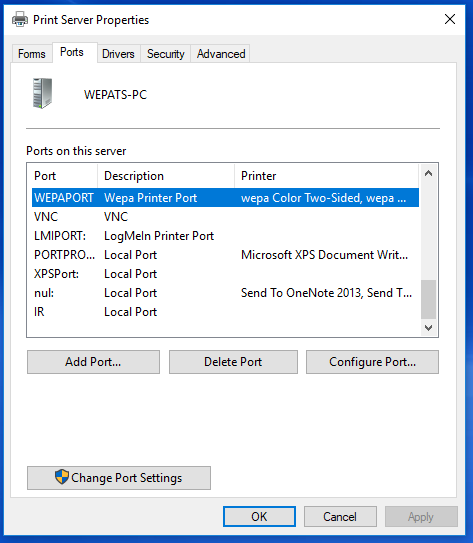
  3. To verify that the Wepa port was installed, open the Control Panel and choose Devices and Printers. Select the Wepa printer.
  4. Choose “Print server properties” at the top and go to the Ports tab
  5. After confirming the presence of WEPAPORT, rerun the Wepa Print App for Windows installer.

Click here for more information about the Wepa Print App for Windows.