

- The Linux Print App is the most flexible way to print from a Linux computer.
- Print from any software by choosing File > Print and selecting a wēpa printer.
- The Linux Print App is currently available as a Debian package for x64 and ARM64 systems.
Quick Start: Download the Linux Print App Debian package that matches your system architecture and install it.
Download Linux Print App for deb (x64) Download Linux Print App for deb (arm64)
Website Download
Go to wepanow.com/software to download the latest version.
Latest Version: 2026.7.10
Installation
Install the Debian package
Open Terminal in the folder where the Debian package was downloaded, then run:
sudo apt install ./wepa_print_app-linux-<arch>-<version>.deb
What the package installs
The Linux package installs the application, creates the required folders, and adds the wēpa CUPS printer queues.
| Item | Linux Location / Name |
|---|---|
| Package name | wepa-lpa |
| Main binary | /usr/lib/wepa-lpa/wepa-lpa |
| Command symlink | /usr/bin/wepa-lpa |
| Crash report utility | /usr/lib/wepa-lpa/CrashReporter |
| Shared settings file | /var/lib/Wepa/Settings.xml |
| Log folder | /var/log/com.wepa.printapp/ |
| Spool folder | /var/spool/WepaQueue/<username>/ |
Linux app shortcuts
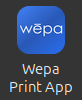
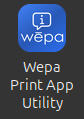
After installation, the system will show shortcuts for the Wepa Print App and Wepa Print App Utility. The utility is used to collect and send logs when troubleshooting issues.
Choose personal or shared / public setup
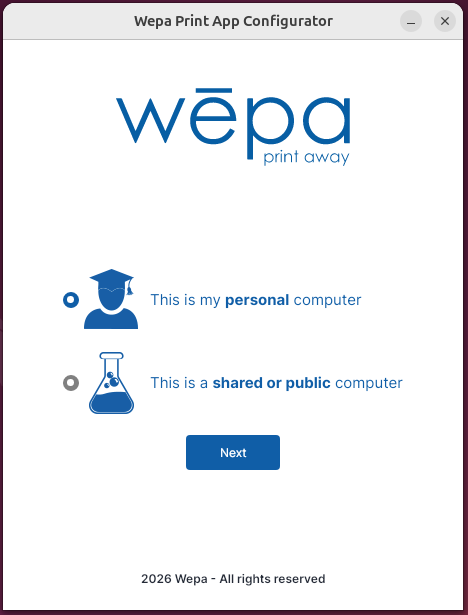
When the application launches, select This is my personal computer if installing on a personal Linux computer or This is a shared or public computer if installing on a shared or public computer, such as a lab environment. Click Next to proceed.
Select your school or institution
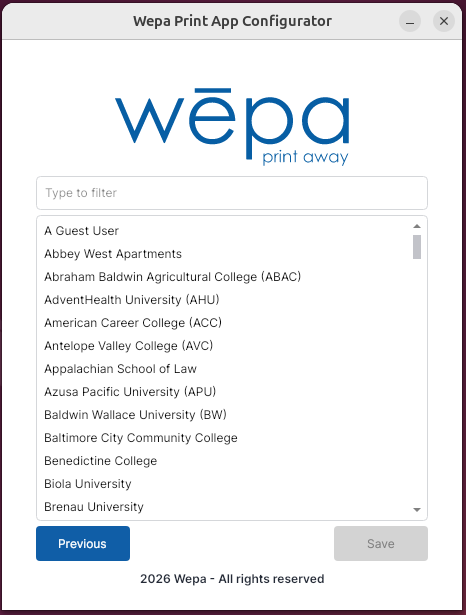
Select your school or institution. If you are not affiliated with one, choose A Guest User.
Lab / Public Options
Confirm shared / public setup
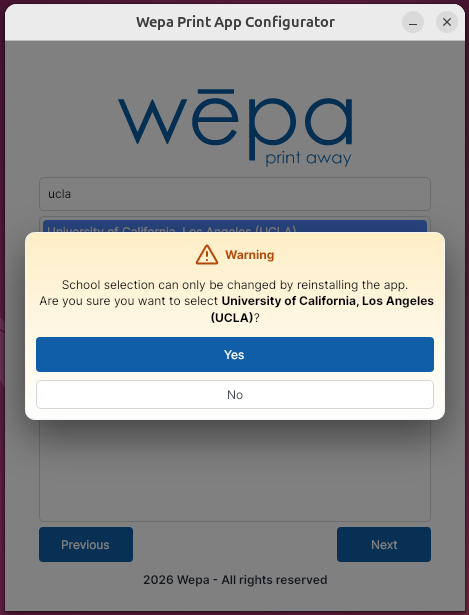
After you choose the school, you are notified that this choice can only be changed by uninstalling and reinstalling the application.
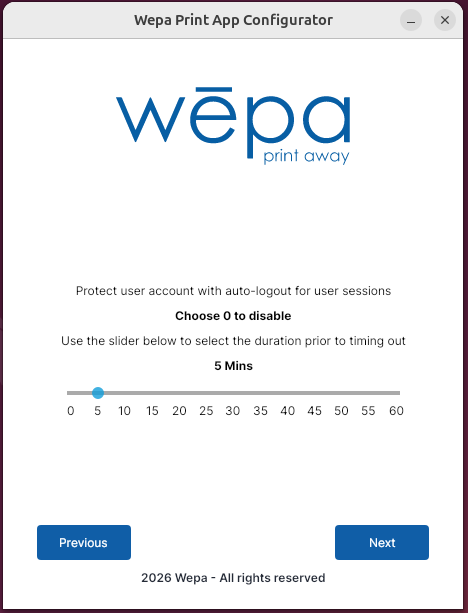
Configure session timeout
Set a session timeout value. The Session Timeout controls when users are prompted to log out or stay signed in. Set the value to 0 to disable the session timeout when users log in and out of Linux with their own accounts.
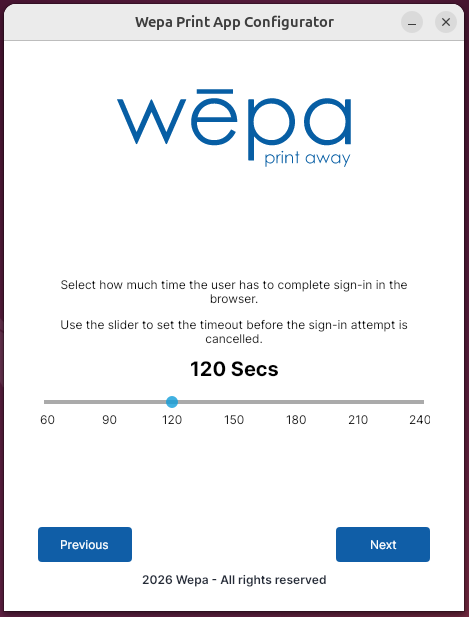
Configure Single Sign-On timeout
For Single Sign-On schools, configure the Single Sign On (SSO) Timeout. This controls how long users have to complete browser sign-in before the attempt is canceled.
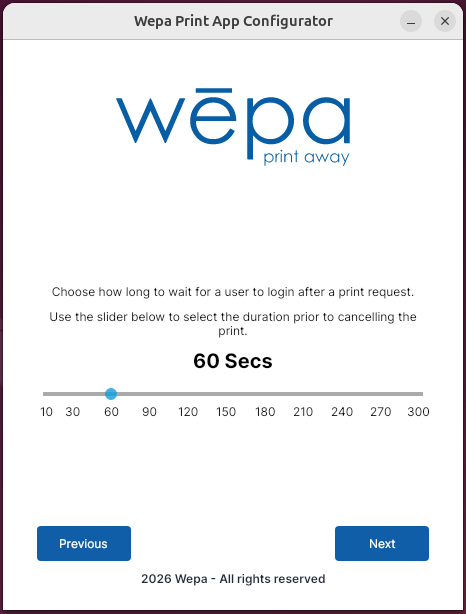
Configure force timeout
The Force Timeout controls how long the Print App waits for a user to log in or choose guest printing after a print request starts.
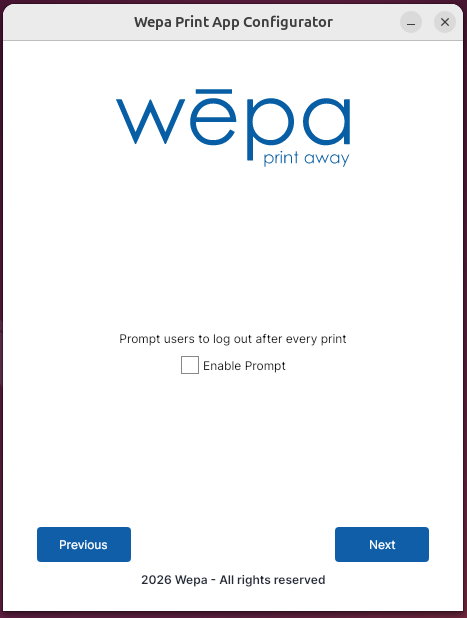
Configure logout prompt
Enable Logout Prompt prompts users to sign out after successfully uploading a print job, which helps protect account security on shared devices.
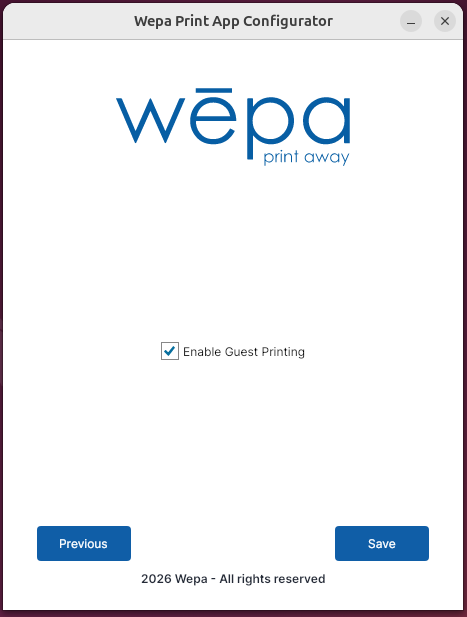
Configure guest printing
Allow Guest Printing lets users submit print jobs without signing in or creating an account. A release code will be provided so the user can release the document at a print station.
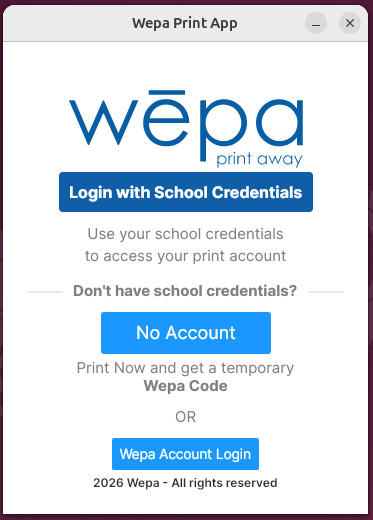
Login screen
For Single Sign-On schools, users will see a Login with School Credentials button. Selecting this option launches an external browser so users can sign in on the school’s login page. If Guest Printing is enabled, select No Account to print without signing in and receive a wēpa code.
How to Print
From any software that can print, choose File > Print, select a wēpa printer from the drop-down menu, and select Print. If you are not already signed in, a login prompt will appear.
CUPS printer queues
The Linux package installs the following wēpa CUPS printer queues:
- wepa_BW — black and white
- wepa_BW_Two_Sided — black and white, two-sided
- wepa_Color — color
- wepa_Color_Two_Sided — color, two-sided
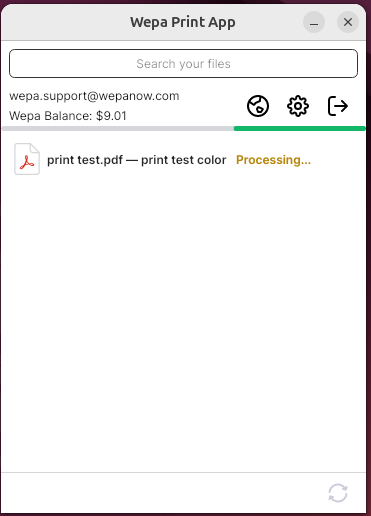
Upload processing
The Linux Print App will show the print job while it is uploading or processing.
Guest release code
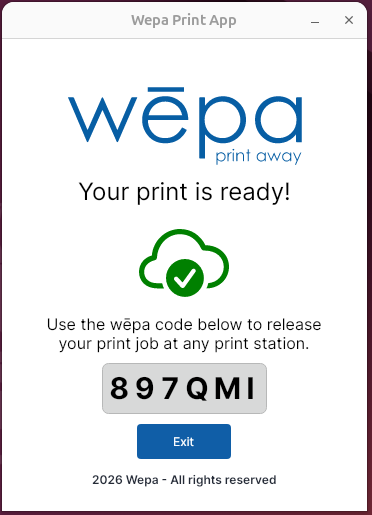
If guest printing is used, the Guest Printing window will process and upload the document, then provide a wēpa code to use at any print station.
Lab logout prompts
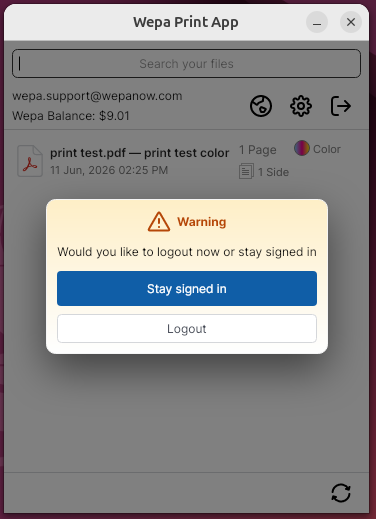
Lab Only: If prompt to logout after every print is enabled, a window will appear requesting the user to stay signed in or log out after each upload. Select Logout if finished printing to ensure the next user will not print to your wēpa account, or select Stay signed in if continuing to print.
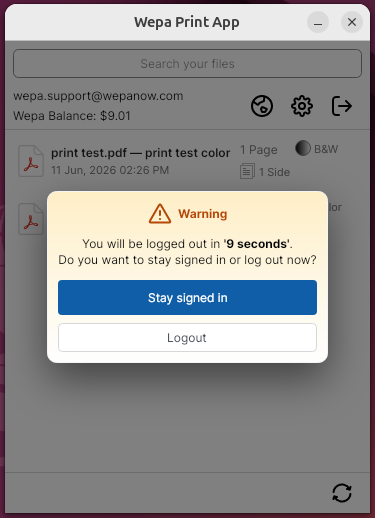
Lab Only: If the session timeout is enabled, a window will appear requesting the user to stay signed in or log out after the configured amount of time has passed without a print.
Settings and Troubleshooting
Submit Crash Report
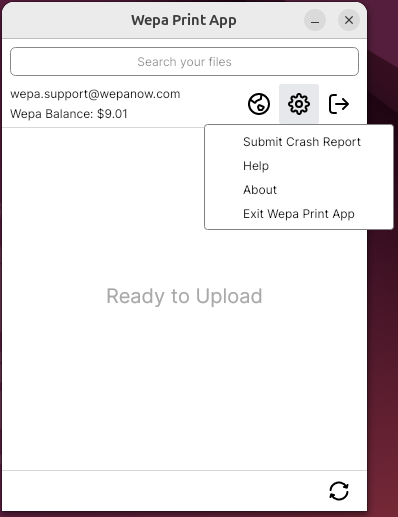
Select the settings option to view additional tools and support options. Click Submit Crash Report to email necessary logs to wēpa support. If the option is unavailable, use the manual log locations below.
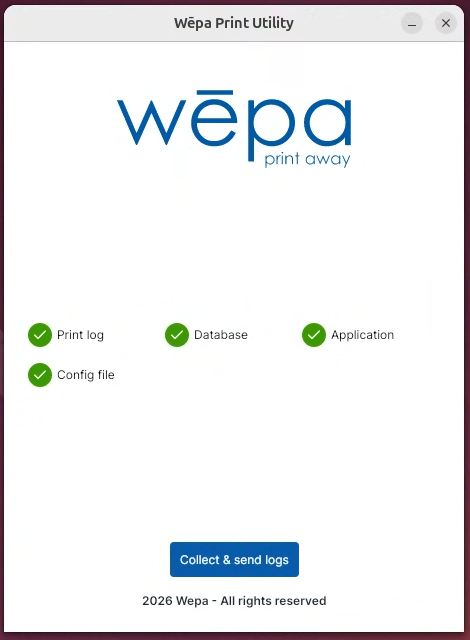
Wepa Print App Utility
The Wepa Print App Utility can also be used to collect and send logs if the main app cannot submit the crash report.
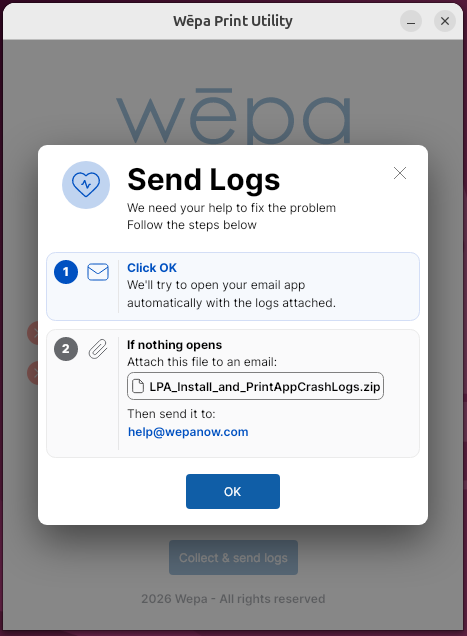
Send logs
A Send Logs message will appear after the logs are collected. Select OK to open your email app automatically with the logs attached.
Linux File Locations
The Linux Print App uses shared system locations for settings, logs, and spool files.
| Item | Linux Location | Notes |
|---|---|---|
| Settings file | /var/lib/Wepa/Settings.xml | The shared lab configuration file. For deployment, install or copy the lab configuration to this path after installing the package. |
| Print app logs | /var/log/com.wepa.printapp/ | Send PrintApp.log, PrintApp.Secondary.log, wpapdfqueue_log, and any other recent files if present. |
| Crash logs | /var/log/com.wepa.printapp/ | Send any recent timestamped .txt crash files from this folder. |
| Spool files | /var/spool/WepaQueue/<username>/ | Temporary print app spool location for the Linux user. |
Uninstalling
To uninstall the Linux Print App on Debian-based systems, use apt remove or apt purge.
Remove the application
Use remove to uninstall the application package while leaving related configuration files behind.
sudo apt remove wepa-lpa
Purge the application and package configuration
Use purge when you want to remove the application package and package-managed configuration files.
sudo apt purge wepa-lpa